Progressive Overload Basics: How to Add Load and When to Deload
Progressive overload means gradually asking your body to do a little more than it did last time, so it keeps adapting. You can add weight, reps, sets, or other demands, as long as you change one thing at a time and write it down. Every few weeks you also pull back on purpose, which is called a deload. Done with a coach and a written plan, this is the simplest way to keep getting stronger without stalling or getting hurt. At Level Up Gym, every new member starts with a free class or consult and a written, individualized plan, so the progression is mapped out before your first heavy set.
Level Up Gym
levelupgym.app
Build Strength With a Clear Plan
Level Up Gym offers coached strength training in Stratford and Bridgeport for adults who want to progress with guidance.
TL;DR
- Progressive overload is gradually increasing the load or stress on your muscles so they keep getting stronger. Cleveland Clinic describes it this way.
- Change one variable at a time: weight, reps, sets, rest, tempo, or frequency. Small jumps add up quickly.
- Challenge should feel hard but controlled. Pain, or struggling to finish a set, means the weight is too heavy.
- A deload is a planned lighter stretch, commonly every 4 to 8 weeks, lasting about a week.
- Write every session down. Without a log, you are guessing.
Table of Contents
- What progressive overload actually is
- Six ways to progress (with real numbers)
- Weight or reps: which should a beginner pick?
- How to know the jump is right
- Track everything
- A beginner’s four-week example
- When progress slows: the deload
- Common mistakes
- If you box or train in a hybrid format
- Where we come in
- Our perspective
- FAQ
- Sources
What progressive overload actually is
Your body adapts to the stress you give it. Lift a 10-pound dumbbell for ten curls every week, and after a while that stops being a reason to get stronger. Your muscles have already adjusted. Progressive overload is the fix: you raise the demand a little at a time so there is always a reason to adapt.
Cleveland Clinic’s guide defines it as gradually increasing the load or stress on your muscles to promote gains in strength, muscle, and endurance. The key words are “gradually” and “progressive.” A big jump in weight is not overload, it is a quick route to a sore joint.
The same logic holds beyond muscle. Bones respond to load too, which is why guides on osteogenic loading at home talk about applying more demand over time. Whether you want to lose fat, build strength, or hit a heavy bag with better power, the principle is the same.
Why it matters if you want fat loss
Muscle is what you are protecting and building while you eat less and move more. Lifting the same light weights forever gives your body no reason to hold on to or add muscle. Progressive overload gives it one. That is why we pair strength work with conditioning and nutrition coaching rather than treating them separately.
Six ways to progress (with real numbers)
Most beginners think overload means adding plates. It does not. Weight is one lever among several, and the others are often easier on your joints and schedule.
1. Add weight
Cleveland Clinic’s example is a bicep curl at 5 pounds in week 1, 10 pounds in week 3, and 15 pounds in week 5. Its rule of thumb is to add 5 pounds when you could do five more reps on your last set. Small steps work: a study of college-aged men and women found that 0.5-pound increments at 7 to 8 reps and 1-pound increments at 9 or more reps built strength as well as traditional progression over eight weeks.
So if your gym only has big jumps, you can still progress by adding reps first, then weight.
2. Add reps
Cleveland Clinic gives a rep ladder: three sets of 6 reps, then 10, then 15. When you reach the top, drop back to 6 to 10 reps and add weight. This is often called double progression, and it is the easiest system for a beginner to track.
Here is a worked example with goblet squats:
WeekWeightSets x reps
1
25 lb
3 x 8
2
25 lb
3 x 10
3
25 lb
3 x 12
4
30 lb
3 x 8
The weights here are an illustration, not a prescription. Your starting number depends on you.
3. Add sets
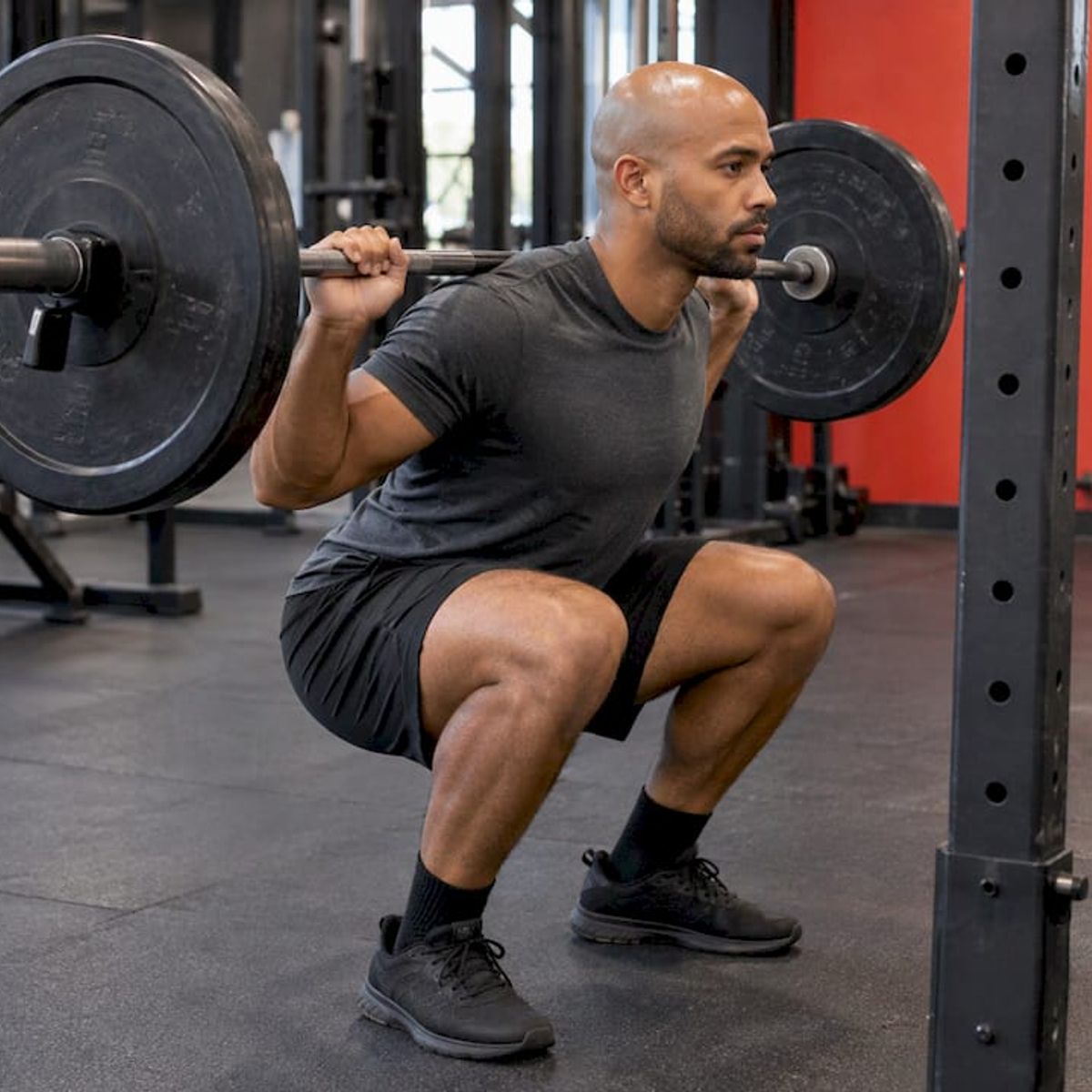
BarBend’s programming guide shows a back squat at 80% of your one-rep max (the heaviest single rep you could do) for 5 sets of 5 in week 1, 6 sets of 5 in week 2, and 7 sets of 5 in week 3. More sets mean more total work at the same weight.
4. Add intensity
The same guide moves that squat from 80% to 82% to 85% of one-rep max across three weeks, with two-minute rests in the third. This is more advanced. A beginner does not need to calculate percentages to get started.
5. Add frequency
Train the same lift twice a week instead of once. If you are new, this can be the most effective change because you practice the movement more often. Our guide to strength training three days a week shows how that schedule can fit a busy week.
6. Change tempo, rest, or duration
Cleveland Clinic lists slowing a lift from a 3-0-1-0 tempo to 5-0-1-0, shortening rest from 60 seconds to 30, and stretching a session from 30 to 60 minutes as valid ways to progress. Healthline adds a running example: 20 minutes twice a week in week 1, building to 30 to 40 minutes three times a week by week 5.
Weight or reps: which should a beginner pick?
Either. Both work. Pick the one you can track consistently. If you are learning a new lift, add reps first: you get more practice at the same weight, and your form gets better before the load rises. Once you hit the top of your rep range with clean form, add weight.
Cleveland Clinic recommends changing one factor at a time, such as load, reps, workout duration, pace, or rest interval. If you add weight and cut rest and add sets in the same week, you will not know what caused a problem when one appears.
How to know the jump is right
The goal is challenge, not pain. Cleveland Clinic’s Dr. King says that struggling to finish a set or feeling pain is a clear sign the weight is too heavy. Use that as your rule:
- Last two reps are hard but your form holds: the weight is right.
- Form breaks, you hold your breath, or you grind the final rep: drop back.
- Sharp or joint pain: stop the set. If it keeps happening, see a doctor or physical therapist before you keep loading it.
- Everything feels easy: add a rep or a small amount of weight next session.
New lifters also get sore. Some soreness after a new exercise is normal, and our workout soreness guide explains how to tell it apart from something that needs rest.
Track everything
Overload only works if you know what you did last time. Write down the exercise, weight, sets, reps, and how hard it felt. Your phone’s notes app is enough. Next session, your only job is to beat one number by a small amount: one more rep, five more pounds, or ten seconds less rest.
Here is a simple log entry:
- Goblet squat, 25 lb, 3 x 10, last set felt like a 8 out of 10, form good.
- Next time: 3 x 12 at 25 lb.
If you want this done for you, our coaches build it into a written plan, which is part of how every member starts.
A beginner’s four-week example
Here is how one lower-body and upper-body pattern could look for someone training twice a week. Use it as a template, not a prescription.
Week 1Week 2Week 3Week 4
Squat pattern
3 x 8
3 x 10
3 x 12
Add weight, 3 x 8
Push (press or push-up)
3 x 8
3 x 10
3 x 12
Add weight or a harder variation, 3 x 8
Row
3 x 10
3 x 12
Add weight, 3 x 8
3 x 10
Carry or core
20 seconds
25 seconds
30 seconds
30 seconds, heavier
Notice that nothing jumps by more than one variable per week. That is the whole trick. Our guide to building strength with limited equipment shows how to apply these steps if you only have a few dumbbells or bands at home.
When progress slows: the deload
No one adds weight or reps forever. Eventually fatigue builds, sleep suffers, and the numbers stall. A deload is a planned lighter period where you stay active but reduce your usual intensity or volume, giving your body room to recover.
What a deload looks like
Cleveland Clinic suggests cutting weight, reps, and sets by up to 50%, easing your effort, choosing lighter activities such as hiking, or training fewer days. Men’s Health puts the typical reduction at 30 to 50% of volume, load, or both. For runners, it suggests cutting total mileage by 20 to 40% after three to four weeks of increased mileage.
The NSCA’s practical guide to deloading gives more specific options. You can lower intensity by about 10% of your one-rep max while keeping reps the same, cut sets, or leave more reps in reserve (stop 1 to 3 reps before you would fail). If fatigue is extreme, reduce how many days you train.
A simple version for a beginner:
- Keep the same exercises and the same days.
- Cut the weight by about 10%, or cut your sets in half.
- Stop every set with 3 reps still in the tank.
- Go back to progression the following week.
When to deload
There are two approaches, both described by Men’s Health:
- Proactive: scheduled every four to eight weeks between hard blocks. The NSCA also describes deloads commonly planned every 4 to 8 weeks and typically lasting 5 to 7 days.
- Reactive: taken when gains slow and you start to feel burned out.
Beginners usually do well with a proactive deload because you do not have to read your own body signals perfectly. Pick a week, put it on the calendar, and treat it as part of the plan. If you notice your lifts dropping, your sleep getting worse, or workouts feeling like a chore, take the reactive version sooner.
We cover this more in the role of recovery in training.
What you get out of a deload
A deload is not a lost week. You keep the movement patterns fresh, your joints and muscles get a break from heavy loading, and you tend to return to the next block feeling ready to add weight again. It is the part of the plan that makes the next four to eight weeks of progress possible.
Common mistakes
- Jumping too fast. Rapid increases raise your chances of overuse problems. Smaller steps feel slow and work better.
- Changing everything at once. Change one variable at a time so you can tell what works.
- Skipping the log. If you cannot see last week’s numbers, you cannot beat them.
- Chasing failure every set. You do not need to go to absolute failure to progress. Leaving a few reps in reserve is enough for most sessions.
- Never taking a lighter week. Grinding through fatigue is how a plateau turns into a flare-up.
- Trying to progress everything. Balance your strength and cardio. Our guide on how to balance strength and cardio sessions helps you split your week.
If you box or train in a hybrid format
Progressive overload is not only for barbell lifters. In boxing, overload can be more rounds, a faster pace, shorter rest between rounds, or heavier strength work that supports your power. Our article on boxing strength training shows how the strength side of that week fits together. The deload idea applies too: if you box four days a week, a lighter week lets your hands, shoulders, and legs recover.
Where we come in
If you train near Stratford, Bridgeport, Fairfield, or Milford and want the progression planned for you, we can do that. Every new member starts with a free class or consult and a written, individualized plan. Classes are capped in size, and our certified coaches, including pro boxers, give personal attention. There are no contracts.
Large group classes run $24.99 to $59.99 per week. Small group personal training (2 to 4 people) runs $74.99 to $174.99 per week per person, and 1-on-1 personal training runs $149.99 to $359.99 per week. If you are brand new, the 6-week Onramp is $699 one-off. Details are on our membership page and the 6-Week Onramp page.
If you would rather try a class first, our free boxing class in Stratford is an easy way to get started.
Our perspective
Most people who stall in the gym are not lazy and not unlucky. They are guessing. They lift the same weights for the same reps, then wonder why nothing changes. Or they jump too far, get sore or hurt, and stop for a month.
What we want is boring progress that adds up. A rep here, five pounds there, a lighter week planned before you need it. We build that into a written plan for every new member, and we keep classes capped in size so a coach can watch your form while the load goes up.
That matters for the students and commuters we train. You have class, work, and a schedule that changes every week. A plan that says exactly what to do next, with a coach who knows your last session, takes the guessing out. And whether you come for strength, fat loss, or real boxing coaching rather than cardio boxing, the principle is the same: small steps, tracked, with recovery built in.
Malcolm
FAQ
What is progressive overload in simple terms?
It means gradually making your training harder so your body keeps adapting. You can add weight, reps, sets, speed, or training days. The key is small, planned steps and a written record of what you did.
How often should I add weight or reps?
There is no single schedule. A common beginner pattern is to add reps each week until you reach the top of your range, then add a small amount of weight and start the range again. Cleveland Clinic’s examples add weight every couple of weeks. If a jump makes you struggle to finish a set or causes pain, it was too big.
How do I deload, and how long should it last?
Keep your usual exercises and days, but cut your weight, sets, or reps by roughly 30 to 50%, or stop each set with more reps in reserve. The NSCA says deloads typically last 5 to 7 days. Then go back to your normal progression.
When should I take a deload week?
Many lifters plan one every four to eight weeks. You can also take one when your gains slow and you feel worn down. If you are new, scheduling it in advance is the easier habit.
Can I use progressive overload with bodyweight or limited equipment?
Yes. You can add reps, slow the tempo, shorten rest, or move to a harder variation, such as going from incline push-ups to floor push-ups. Those all raise the demand without needing heavier weights.
Sources
- Should You Try Progressive Overload Training? (Cleveland Clinic)
- Why You Should Have a Deload Week (Cleveland Clinic)
- The Guide to Deload Weeks (Men’s Health)
- A Practical Guide to Deloading (NSCA)
- 6 Easy Ways To Start Programming Progressive Overload (BarBend)
- Progressive Overload: What It Is, Examples, and Tips (Healthline)
- The Effectiveness of 0.5-lb Increments in Progressive Resistance Exercise
- Osteogenic Loading at Home