5 Coach Led Mitt Work Drills That Build Reaction Speed and Footwork
Prioritize five drills: the 1-2, the 1-2-3, the 8-count, footwork-integrated combos, and slip-and-counter sequences, done in short, focused sessions two to four times a week. This mix sharpens timing, accuracy, and conditioning faster than random punching because it trains the nervous system to react, not just repeat. Level Up Gym’s warm-up drills and the ACSM frequency guidance supports this pacing for beginners building a real skill base.
TL;DR:
- Mastering the fundamental punches like 1-2, 1-2-3, and 8-count sequences develops muscle memory, reaction, and rhythm essential for advanced boxing.
- Adding footwork exercises, such as pivots and lateral movement, improves range control and simulates real ring scenarios more effectively.
- Incorporating reaction and visual drills enhances hand-eye coordination and response times, which are critical for fight accuracy and defense.
- Proper warm-up routines and gradual session progression prevent fatigue and reinforce technical consistency, reducing bad habits.
- Consistent coaching and structured drills, including slow cue-driven reps and corrective feedback, accelerate skill acquisition and minimize ingrained errors.
Level Up Gym
levelupgym.app
Build Sharper Boxing Skills
Level Up Gym combines coached boxing with hybrid training for Fairfield County adults, and beginners are welcome to start building real technique.
Table of Contents
- Core mitt drills every beginner needs to learn
- Add footwork to your mitt drills for real ring movement
- Defense and counter drills that build real reaction speed
- Warm-up, conditioning, and safety every mitt session needs
- Progression and two sample mitt sessions to try
- Fixing the technical errors that slow beginners down
- Why this mitt work progression actually works
- Train mitt work with real coaching, not guesswork
- FAQ
- Sources
Core mitt drills every beginner needs to learn
Every mitt session starts with the same four punches: jab, cross, hook, and uppercut, numbered 1 through 4 in that order. This numbering comes from standard boxing-inspired workout terminology, and it’s the language your coach will use to call combinations, so learn it before anything else.
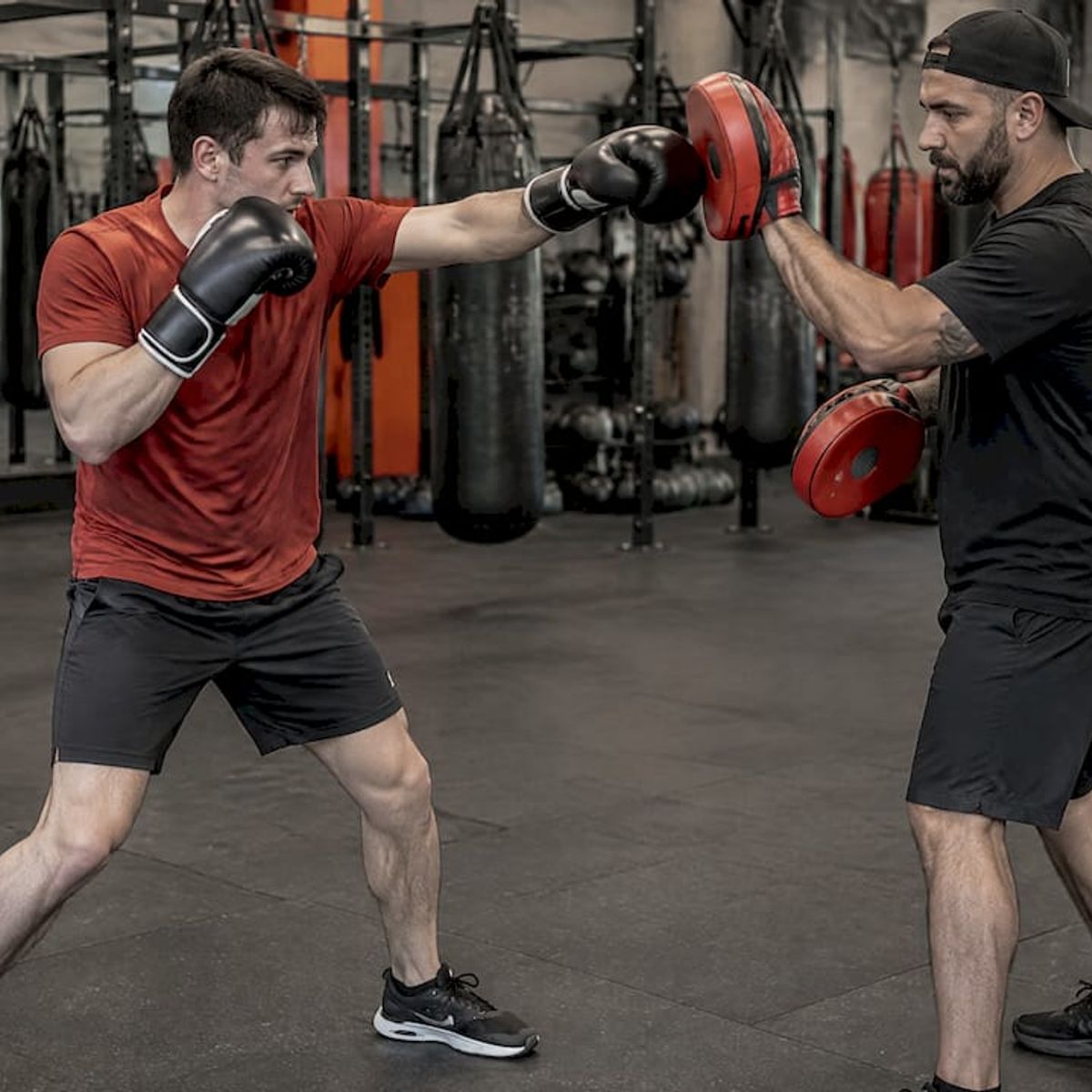
The 1-2 is the jab-cross, the foundation of almost every combo in boxing. The jab snaps out to set range and distance, then the cross follows behind it with hip rotation and weight transfer. Two useful variations build on this: the double jab (1-1-2), which teaches you to reset your lead hand quickly, and jab-to-body (1 to the body, 2 to the head), which trains level changes without dropping your guard.
Once the 1-2 feels automatic, add the hook. The 1-2-3 (jab-cross-hook) teaches rotation on the third punch, pivoting the lead foot while keeping the rear hand up to guard the chin. From there, 1-2-1-2 rhythm work builds a steady cadence, teaching you to throw combos in a loop without pausing between reps. This is less about power and more about building a punch rhythm you can hold for a full round.
The 8-count drill is where beginners often plateau, so it deserves careful setup. The holder calls out a sequence of eight numbers (for example: 1, 2, 3, 2, 1, 2, 3, 2), and you throw the full sequence on command, treating it as one continuous combination rather than eight separate punches. Start slow, prioritizing clean form and full extension on each punch. Once the pattern is memorized, the holder can call it faster or mix in body shots, rewarding accuracy over speed at first and only adding speed once the pattern holds together under fatigue.
Reaction and visual drills round out a beginner’s early toolkit, underscoring why hand-eye coordination matters for developing sharp reaction skills. Instead of a memorized sequence, the holder calls random numbers one at a time (a “go” drill), or presents mitts without a verbal cue and expects a reaction punch (a “no-go” check, where you must not punch if the mitt doesn’t move into position). This kind of randomized target work matters more than it looks. Research on visual ability and punch performance found that reaction time, eye-hand coordination, and depth perception strongly predict punch accuracy in competition, meaning drills that force real decisions beat drills that just repeat a pattern.
A simple structure for a beginner mitt round:
- Round 1: 1-2 and 1-1-2 only, slow and deliberate, focusing on form.
- Round 2: 1-2-3 and 1-2-1-2, moderate pace, focusing on rhythm.
- Round 3: 8-count sequences, holder calling two or three variations.
- Round 4: Random single-number calls, full reaction speed.
Pro Tip: Count punches out loud with your holder during the first few sessions. Hearing the number as you throw it locks the name to the motion faster than silent repetition.
Add footwork to your mitt drills for real ring movement
Mitt work that never moves your feet teaches you to punch, not to fight. Once the basic combos are solid, your holder should start moving, forcing you to adjust range and angle on every exchange. This is where boxing starts to look less like hitting a target and more like solving a moving problem.
Start the pivot drill stationary. Throw a 1-2, then pivot on your lead foot about 45 degrees while your holder stays still, resetting your stance before the next combo. Once that feels natural, have the holder step laterally after every combo, forcing you to pivot toward open space instead of a fixed spot. This single change teaches angle-creation, which separates beginners who stand and trade from boxers who control distance.
In-and-out footwork pairs naturally with the 1-2. Step in with the jab, land the cross, then push off the back foot to exit before the holder can counter. Forward-and-back pacing drills extend this: the holder advances and retreats in a loose pattern, and you match the rhythm with your combos, throwing only when your base is set rather than while still moving.
A few cues make or break this stage:
- Keep your weight centered over both feet between combos, never leaning on your lead leg.
- Push off the ball of your back foot when exiting, not your heel.
- Reset your hands to guard position before your feet finish moving, not after.
- Treat every pivot as a chance to create an angle, not just to turn around.
Inside-fighting drills bring the mitt work closer. With the holder stepping in tight, you practice short hooks and uppercuts in a compact range, learning to keep your elbows in and your punches short rather than looping them. On-the-ropes progressions simulate being cornered: the holder pins you against an imaginary rope line, and you practice pivoting off the ropes with a combo rather than standing and absorbing pressure. For more structured footwork progressions outside of mitt work, Level Up Gym’s footwork drills build the same patterns without a partner.
The transition cue that ties all of this together: every combo should end with your feet already moving toward your next position, not planted. That’s the difference between mitt work that trains punching and mitt work that trains boxing.
Defense and counter drills that build real reaction speed
Defense is where most beginner mitt work falls short, because it’s tempting to spend the whole round punching. Slip-and-counter drills fix this directly. The holder throws a mitt forward like a jab, you slip to the outside or inside, and immediately return a counter, starting slow enough that the timing is deliberate rather than guessed.
- Slip-and-counter: holder presents a slow jab mitt, you slip and return a 1-2, gradually increasing holder speed as your timing improves.
- Roll-and-return: holder presents a hook-angle mitt, you roll under it and counter with a body shot or hook of your own, with the holder keeping the mitt at a safe, predictable height.
- Catch-and-return: holder throws a straight mitt, you catch it with your opposite glove and immediately fire a counter off the catch.
- Randomized calling: holder mixes slips, rolls, and catches with no pattern, forcing you to read the mitt angle in real time rather than anticipating.
The goal at every stage is the same: defense without an immediate counter is only half the skill. Moving your head or catching a shot and then pausing wastes the opening a real opponent would punish you for ignoring. Start every new defensive drill at a pace slow enough to be clean, then let the holder speed it up only once your counters land consistently.
Warm-up, conditioning, and safety every mitt session needs
A proper warm-up matters more for mitt work than for most boxing drills because the pace and intensity ramp up fast once combos start. Level Up Gym’s coach warm-up routine is built around three phases: light jump rope to raise heart rate, joint mobility work for the shoulders and hips, and short activation sets like shadow combos at half speed.
A basic checklist before any mitt round:
- Three to five minutes of jump rope or light cardio to raise body temperature.
- Shoulder circles, hip rotations, and ankle mobility to prep joints for sudden direction changes.
- One or two shadow boxing rounds at low intensity to rehearse combos before contact.
- A quick check of wrap and glove fit before the first real round.
Mitt work is more demanding than most beginners expect. A study comparing pad and bag training in boxers found pad routines produced a higher average heart rate and oxygen consumption than bag work, meaning mitt rounds carry a real cardiovascular load on top of the skill work. That extra demand is why beginners should build up round count gradually rather than jumping straight into long sessions.
For weekly frequency, the ACSM’s cardiorespiratory guidance recommends 3 to 5 days of exercise per week for general fitness benefit, a range that fits well for mitt-focused training mixed with rest or strength days. On the holder’s side, mitts should be presented at a stable angle, hands relaxed enough to absorb impact, and contact should start light and build only as the puncher’s control improves. Stop the drill immediately if form breaks down. Fixing technique at half speed beats grinding through fatigue.
Progression and two sample mitt sessions to try
Skill builds in layers: master a punch, then a combo, then add movement, then add randomness. Trying to do all four at once is why many beginners feel stuck after a few weeks. These two templates show what that progression looks like in practice.
Beginner template, about 20 minutes:
- Warm-up: 3 minutes jump rope, 2 minutes mobility and shadow boxing.
- Round 1 (3 minutes): 1-2 and 1-1-2 only, slow pace, focus on form.
- Round 2 (3 minutes): 1-2-3 combos, moderate pace.
- Round 3 (3 minutes): basic 8-count sequences with the holder calling two patterns.
- Cooldown: 2 minutes light shadow boxing and stretching.
Intermediate template, about 30 minutes:
- Warm-up: 5 minutes jump rope and mobility work.
- Round 1 (3 minutes): 1-2-1-2 rhythm work with footwork pivots added.
- Round 2 (3 minutes): in-and-out combos with forward and back pacing.
- Round 3 (3 minutes): slip-and-counter and roll-and-return drills at building speed.
- Round 4 (3 minutes): fully randomized number calls, mixing offense and defense.
- Cooldown: 3 minutes stretching and breathing.
Progress week to week by changing one variable at a time: add a round, shorten the decision window between the holder’s call and your punch, or introduce more randomness before adding speed. Jumping straight to fast, random combos before the basic patterns are automatic usually just reinforces bad habits faster.
Timing matters for reaction-heavy rounds specifically. A study on chronotype and reaction time in boxers found that visual reaction performance varies by time of day depending on whether an athlete is naturally a morning or evening type, with morning-type boxers performing better earlier in the day and evening-type boxers performing better later. If you have flexibility in when you train, scheduling your randomized reaction rounds during your personal peak window can make that portion of the session noticeably sharper.
Fixing the technical errors that slow beginners down
Good coaching cues speed up learning more than extra reps do. Research on motor learning and cueing found that external focus cues, meaning instructions that point attention at the target rather than the body part, produce better skill acquisition for complex movements like punch combos. Telling a beginner to “punch through the mitt” works better than “rotate your hip,” at least until a specific technical flaw needs isolated correction.
Six errors show up constantly in beginner mitt work:
- Dropping the rear hand after a jab, leaving the chin open. Fix with slow reps where the holder taps the exposed chin if the guard drops.
- Overreaching on the cross, leaning the head forward past the lead foot. Fix by shortening the punch until balance holds.
- Resetting hands too slowly after a combo. Fix with a drill that rewards an immediate return to guard.
- Telegraphing punches by loading the shoulder before throwing. Fix by shadow boxing in front of a mirror at slow speed.
- Squaring up the stance during combos, losing power and balance. Fix by cueing a return to the fighting stance between every punch.
- Looking down at the mitts instead of the holder’s eyes. Fix by having the holder call numbers verbally instead of just presenting targets.
Slow a drill down whenever a technical pattern looks inconsistent. Speed only once the movement is clean, since fast reps on a broken pattern just drill in the mistake.
Pro Tip: When coaching more than one beginner at a time, pair them up and rotate holder duties every round. Holding mitts teaches timing and target presentation almost as fast as throwing does.
Why this mitt work progression actually works
Most beginners want to go fast and hit hard on day one, but skill has to come first. Rushing into high-intensity rounds before the 1-2 and 1-2-3 are automatic just locks in sloppy habits that take months to unlearn. Slow, cue-driven reps build the pattern; speed and randomness come after, not before.
Small mitt-work sessions help coaches watch footwork, catch dropped guards, and correct errors in real time, preventing beginners from repeating mistakes unnoticed for an entire round.
— Malcolm
Train mitt work with real coaching, not guesswork
Level Up Gym’s Boxing Classes put these drills in front of a certified coach from day one, with class sizes capped so mitt work gets real correction, not just repetition.
Beginners typically start with the 6-Week Onramp, a structured program built for exactly this kind of progression, or book a free class to try mitt work with a coach before committing. Prefer one-on-one attention or can’t make it to Stratford or Bridgeport? 1-on-1 Personal Training and Online Training both cover the same drill progressions.
FAQ
What is 1, 2, 3, 4, 5, 6 in boxing?
The core boxing numbers are 1 for the jab, 2 for the cross, 3 for the lead hook, and 4 for the rear uppercut, a system used in mitt work calling across most gyms. Numbers 5 and 6 aren’t standardized the same way everywhere. Some coaches use them for a rear hook or lead uppercut, so always confirm the numbering your own coach uses before mitt sessions.
What is the 80/20 rule in boxing?
There’s no single documented “80/20 rule” specific to boxing training in the sources behind this article, and the term is used inconsistently across gyms and coaches. If your coach references it, ask what ratio they mean, since it’s sometimes applied to work-to-rest ratios and sometimes to technique-versus-conditioning time splits.
What is the 30-30-30-30 drill for boxing?
This specific drill name isn’t part of standard boxing terminology covered by the sources behind this article. If a coach uses it, it likely refers to a round structure splitting work and rest into 30-second blocks, but confirm the exact format with whoever is running your session.
Is boxing three times a week enough?
Three sessions a week fits within the ACSM’s recommendation of 3 to 5 days of cardiorespiratory exercise weekly for general fitness benefits. For mitt work specifically, three focused sessions with rest or strength days between them is enough to build real progress without risking the overtraining that comes from too much high-intensity pad work too soon.
Sources
- Physical response to pad- and bag-based boxing-specific training modalities — J Strength Cond Res 2020
- Relationship between visual ability assessment and punch performance in competition — PMC
- The effect of time of day on visual reaction time performance in boxers: evaluation in terms of chronotype
- Boxing-inspired Workout — ACE Fitness