Boxing Footwork Drills That Actually Build Ring Movement
The fastest way to move better in the ring is to drill the step-drag, pivot, L-step, cone or ladder patterns, jump rope, and movement-focused shadowboxing, in that order, for short rounds of one to three minutes each. Master each movement in isolation before adding punches, and never sacrifice stance for speed. The sections below break down exactly how to do each drill, how to string them into weekly sessions, and how to fix the mistakes that quietly wreck most beginners’ footwork.
TL;DR:
- Drilling step-drag, pivot, and L-step movements in isolation is essential for developing proper boxing footwork before combining punches or facing live action.
- Consistent practice of short, focused sessions twice to four times weekly improves stance, balance, and fluidity within four to eight weeks, especially with coaching feedback.
- Common mistakes like crossing feet, standing upright, or pivoting on flat shoes can be corrected through slow-motion self-film analysis, tape markers, and proper footwear.
- Jump rope, cone, ladder, and mirror drills are key tools for building agility, direction change, and rhythm necessary for effective in-ring movement.
- Proper breathing during drills, exhaling on each step or pivot, enhances relaxation, balance, and responsiveness, reducing fatigue and tension.
Table of Contents
- How Do You Practice Boxing Footwork Drills Step by Step?
- How Should You Progress Boxing Footwork Drills Over Time?
- What Are the Most Common Boxing Footwork Mistakes?
- What Equipment Do You Need for Home Footwork Practice?
- Three Ready-to-Run Footwork Sessions
- How Should You Breathe During Footwork Drills?
- A Coach’s View on Building Real Footwork
- Train Your Footwork With Coached Feedback That Catches Mistakes Early
- Sources
- FAQ
How Do You Practice Boxing Footwork Drills Step by Step?
Every drill below builds a distinct skill, but they all rest on the same base: your basic boxing stance. Whether you fight orthodox or southpaw, feet stay roughly shoulder-width apart, knees soft, weight balanced on the balls of your feet rather than your heels. Get that wrong and every drill that follows inherits the flaw.
Step-drag. This is the engine of all boxing movement, and it’s why coaches drill it first with beginners. The rule is simple: whichever foot moves first, drag the other one to match, so your stance width never changes. Step forward with the lead foot, drag the rear foot; step back with the rear foot, drag the lead foot; same logic laterally. Beginners should run this drill in all four directions for two to three minute rounds before adding a single punch. The most common error is crossing the feet mid-step, which kills your balance and leaves you exposed. If you catch yourself crossing feet, slow down until the pattern feels boring.
Pivot. The pivot rotates you around your lead foot to create an angle without stepping away. Plant on the ball of the lead foot, keep hips and shoulders connected, and let the rear foot arc around 45 to 90 degrees. Practicing this pivot mechanic slowly, for sets of eight to ten reps per side, teaches your body the rotation before you ask it to do so under pressure. Pivoting on a flat foot instead of the ball of the foot is the single biggest cause of rolled ankles in beginner footwork work.
L-step and angle exits. Step out at roughly 90 degrees, then reset your stance so you’re facing your target from a new angle. Drill the pattern with no punches first. Once the footwork is clean, add a jab on the exit. The typical breakdown here is the rear foot crossing behind the lead foot instead of stepping wide, which collapses the base right when you need it most.
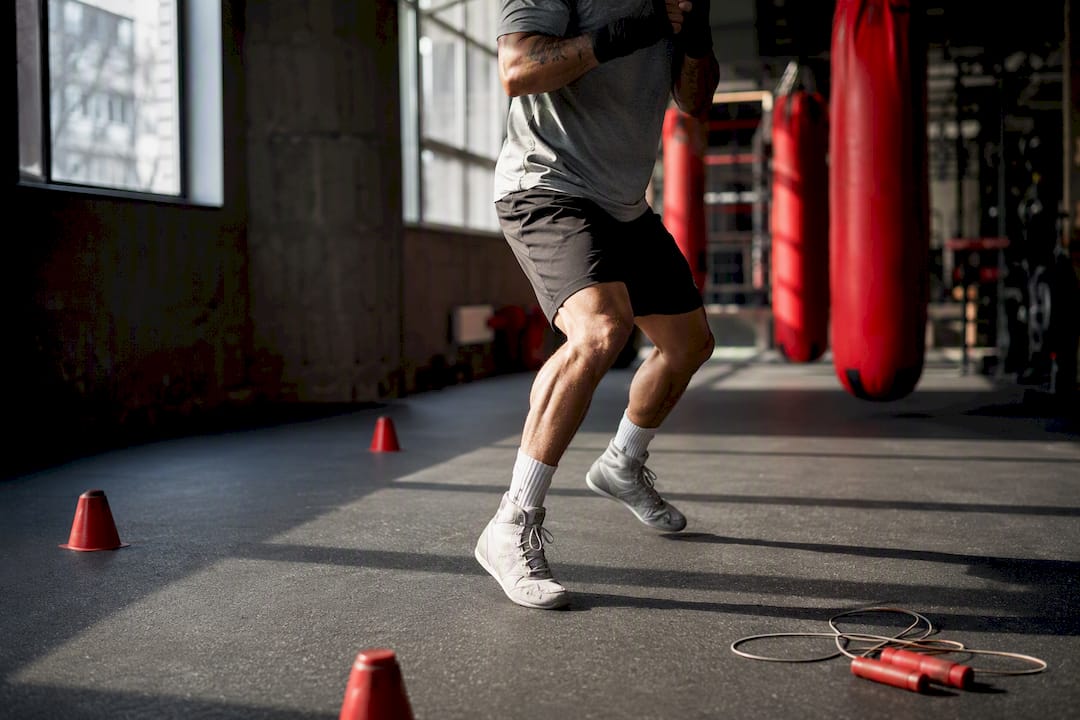
Cone-square and cone weave. Set four cones or markers in a square spaced sufficiently apart and move around the perimeter, throwing a jab on each corner entry. This builds direction-change precision that pure shadowboxing rarely teaches, because it forces controlled entries and exits rather than drifting.
Ladder and line drills. Agility ladder work, including an in-and-out shuffle adapted from the classic Ali shuffle, sharpens foot placement, but only if you stay in a boxing stance throughout. Keep jumps low and resist the urge to square up to the ladder like a track drill.
Jump rope. Several minutes of rope work, including the boxer skip, builds the on-ball rhythm that carries directly into ring movement.
Mirror drill. Face a partner and mimic their movement in real time, then switch leader and follower every 60 to 90 seconds.
Movement shadowboxing. Run rounds where footwork, not punching, is the scored skill. Add strikes only once the movement pattern holds up on its own.
How Should You Progress Boxing Footwork Drills Over Time?
Footwork improves in layers, not leaps. The order that works best follows a clear arc: isolate the movement, then add punches, then shadowbox it, then bring in a partner for a mirror drill, then let it show up live.
- Weeks 1 to 2, technical phase. Drill step-drag, pivot, and L-step in isolation, slow and clean, for three to four short sessions.
- Weeks 3 to 4, tempo phase. Keep the same drills but increase speed and add single punches on the exits.
- Weeks 5 to 8, complexity phase. Combine drills into sequences, introduce cone and ladder work, and bring in partner mirror drills before moving to live application.
Two to four footwork-focused sessions per week is enough for most people, and short one to three minute rounds outperform long unfocused reps because they preserve stance quality instead of letting fatigue creep into the pattern. Rest at least one day between heavy footwork sessions early on. Your feet and calves take on more novel stress from pivots and direction changes than most people expect.
What Are the Most Common Boxing Footwork Mistakes?
Almost every stalled footwork problem traces back to one of a handful of habits.
- Crossing feet during lateral or step-drag movement, which collapses your base and telegraphs your next move.
- Standing too upright, which raises your center of gravity and slows every reaction.
- Pivoting on a flat foot instead of the ball of the foot, which strains the ankle and blunts the angle change.
- Over-rotating on pivots or L-steps, leaving you facing the wrong way when the exchange starts.
- Punching without stepping to finish, so the strike lands but the feet never catch up to support it.
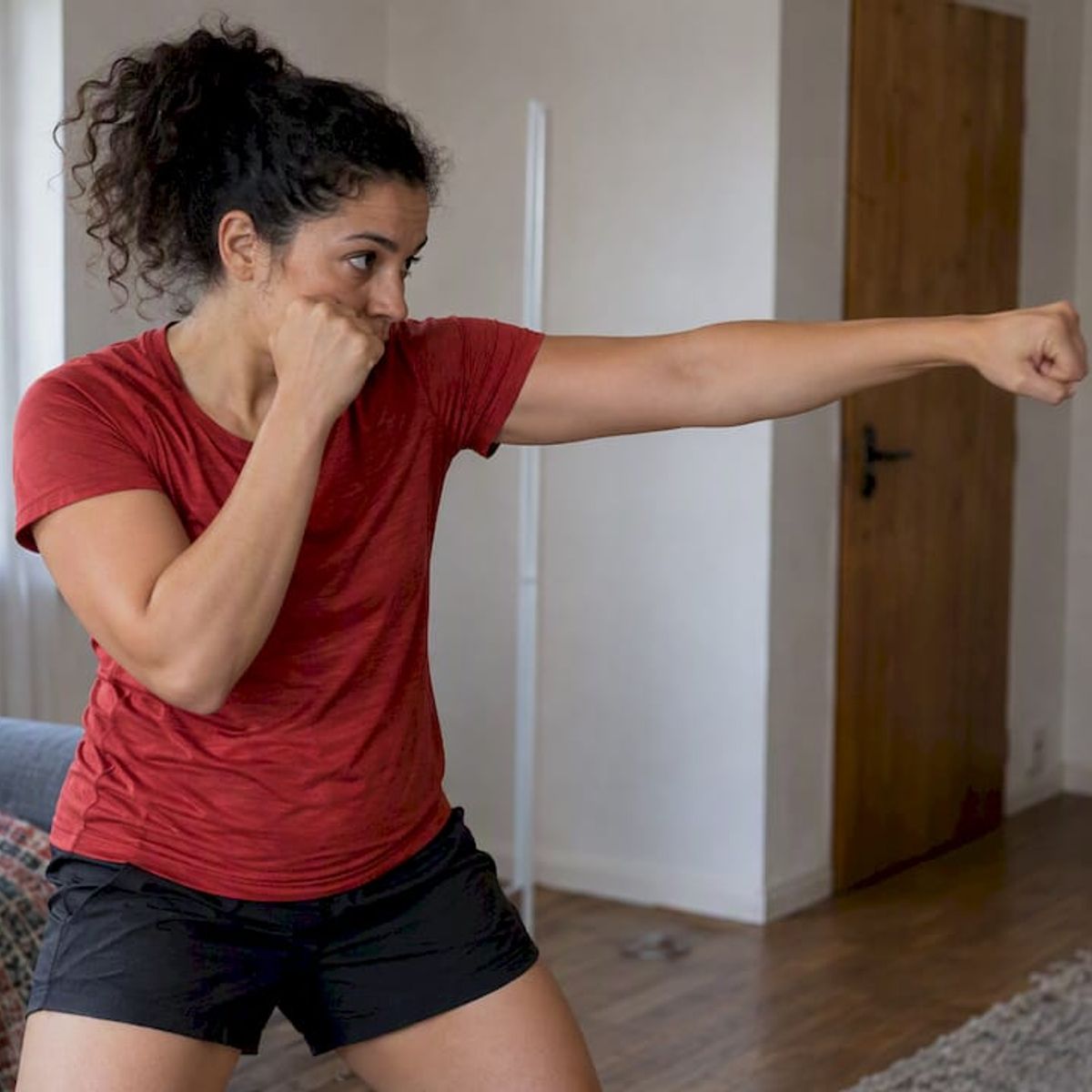
Pro Tip: Film yourself from the side for 30 seconds of shadowboxing, then watch it back in slow motion. Most people are shocked at how upright they stand compared to how low they feel while moving.
Fix these with slow-motion reps, tape markers on the floor to check foot placement, and step-drag regressions any time a more advanced drill starts breaking down. Partner drills and sparring should only happen under a coach’s supervision, and always double-check ankle alignment before speeding up pivot work.
What Equipment Do You Need for Home Footwork Practice?
You don’t need a gym floor to build real footwork. A few basics cover almost everything:
- Painter’s tape to mark a 6x6 foot square with a center line, which supports line drills, cone-square patterns, and pivot markers.
- Water bottles or shoe boxes as free cone substitutes for weave and corner drills.
- A jump rope, the one piece of gear worth actually buying.
- Flat-soled trainers or boxing shoes with a low heel. Skip running shoes with thick, cushioned heels, since they roll your ankle during pivots. Avoid tile or hardwood that gets slippery in socks.
Three Ready-to-Run Footwork Sessions
Pick the session that matches where you are, not where you wish you were.
Beginner (10 to 15 minutes). 1) Step-drag in all four directions, three short rounds. 2) Slow pivots, two sets of eight per side. 3) Two minutes of jump rope. 4) One round of movement-only shadowboxing.
Intermediate (20 to 25 minutes). 1) Ladder or cone work, three rounds. 2) Pivot into jab combos, three rounds. 3) Partner mirror drill, two rounds with role switches. 4) Three rounds of shadowboxing with footwork as the primary focus.
Advanced (30 minutes). 1) High-tempo ladder work, two rounds. 2) Angle-off sequences combined with punch combinations, three rounds. 3) Timed in-and-out power reps, two rounds. 4) Live application, either coached sparring or partner drills under supervision.
Each level builds on the one before it. Jumping straight to the advanced session without the technical base tends to reinforce whatever bad habit you already have, just faster.
How Should You Breathe During Footwork Drills?
Most beginners hold their breath the moment footwork gets demanding, which is exactly backward. Tension in the chest locks up the hips, and locked hips kill the pivot and the step-drag alike.
The simplest fix is to exhale sharply on every step or pivot, the same way you’d exhale on a punch. On step-drag work, breathe out as the lead foot moves and in as you reset. On pivots, exhale through the rotation itself so the breath and the movement finish together. This isn’t about hitting a specific rhythm count. It’s about never letting your breath stop while your feet are moving.
During jump rope rounds, keep breathing shallow and constant through the nose or a relaxed mouth rather than gulping air on every skip. That steadier pattern is part of what makes rope work such an efficient way to build the on-ball rhythm that carries into live movement. When you add punches to any footwork pattern, sync the exhale to the strike, not to the step, since punch mechanics call for a sharper, shorter breath than pure footwork does.
If you notice yourself gasping or your shoulders creeping up toward your ears mid-drill, that’s a signal to slow the round down, not push through it. Clean breathing and clean footwork tend to break down at the exact same moment, so treating one as a warning sign for the other is a useful habit to build early.
A Coach’s View on Building Real Footwork
Footwork doesn’t improve in isolation from strength and conditioning. Hip mobility and single-leg stability, the kind built through strength training that supports boxing mechanics, directly determine how clean a pivot looks under fatigue. At Level Up Gym, footwork gets folded into hybrid classes and the beginner onramp from day one, not bolted on later. If your foot crossing or upright stance hasn’t improved after a few weeks of solo drilling, that’s the signal to get eyes on your movement. Track it simply: fewer crossed feet, smoother pivots on film, more consistent stance width.
— Malcolm
Train Your Footwork With Coached Feedback That Catches Mistakes Early
Solo drilling gets you far, but a coach watching your pivot in real time catches the flat-footed rotation or the crossed step before it becomes muscle memory. Level Up Gym builds footwork correction directly into its boxing classes and its 6-week beginner onramp, so new trainees learn the step-drag and pivot with someone actually checking their stance width and weight distribution. Small-group personal training takes it further, with a coach adjusting your angle exits and mirror drill timing rep by rep instead of leaving you to guess from a video.
Cross-training also matters here. Hip and leg conditioning work, like the kind covered in this surf-specific cross-training guide, builds the same lateral stability that makes pivots hold up under fatigue. If you’re in Fairfield County and want that kind of structured, corrected practice instead of another few weeks of guessing alone in front of a mirror, check out Level Up Gym’s hybrid training programs or find the Stratford location closest to you and book a class.
Sources
- 7 Boxing Footwork Drills for Beginners (At… | Titans Grip
- Boxing Footwork Drills for Beginners: 8 Essential Drills That Build Real Ring Movement - Ask Me Boxing
FAQ
What Is the Best Boxing Footwork Drill for Beginners?
The step-drag is the best starting point because it teaches you to move without breaking stance width, and it should be practiced in all four directions before you add any punches.
How Often Should I Practice Boxing Footwork Drills?
Two to four short, focused sessions per week works for most people, with one to three minute rounds that prioritize clean movement over speed or volume.
What’s the Difference Between Orthodox and Southpaw Stance for Footwork?
Orthodox fighters lead with the left foot and southpaws lead with the right, but the step-drag, pivot, and L-step mechanics are mirrored, not different, so the same drills apply to both.
How Long Does It Take to Improve Boxing Footwork?
Most people notice fewer crossed feet and smoother pivots within four to eight weeks of consistent, short-session drilling, though live application under a coach speeds that timeline considerably.
Can I Do Boxing Footwork Drills at Home Without Equipment?
Yes. A taped 6x6 foot square, water bottles as cone substitutes, and a jump rope cover nearly every drill in this guide, and flat-soled shoes are the only real footwear requirement.
Recommended
- Shadow Boxing Workout: A Complete Beginner’s Guide — Level Up Gym | Level Up Gym
- Boxing and Strength Training: The Science-Backed Method — Level Up Gym | Level Up Gym
- Boxing Workout for Fat Loss: Your 2026 Guide — Level Up Gym | Level Up Gym
- Boxing Training Styles Every Gym Teaches: Your Guide — Level Up Gym | Level Up Gym