
Post-Workout Carbs: How Much to Eat and When It Matters
Eat some carbohydrate with protein after you train, and don’t stress over the exact minute. If you train once a day or less, your total carbs for the day matter far more than a perfectly timed shake. If you train twice in one day, or have a hard session coming within about 8 hours, timing and amount start to count. Below you’ll find the numbers, a worked example, and real food to eat.
Level Up Gym
Fuel Your Training With Confidence
Level Up Gym offers hybrid training and boxing in Stratford and Bridgeport, with coaching for adults and beginners welcome.
TL;DR
- Carbs after a workout refill the glycogen (stored carbohydrate) your muscles burned. They don’t turn into fat just because you ate them after training.
- For most people training once a day, a snack or meal with carbs and protein within an hour or two is plenty. Hitting your daily total matters more.
- Timing gets strict only when your next hard session is under 8 hours away. Then research suggests 1.0 to 1.2 g of carbs per kg of body weight per hour for the first 4 hours.
- Muscle growth comes from lifting and total protein and calories, not from a post-workout carb window.
- Chocolate milk, Greek yogurt with berries, or a turkey sandwich do the job. You don’t need expensive supplements.
Table of Contents
- What carbs do after you train
- Does the timing really matter?
- How many carbs after a workout
- Fast carbs or slow carbs?
- Easy post-workout meals and snacks
- A few real-life schedules
- Our take on post-workout carbs
- Get a plan built around your training
- Mistakes that undercut recovery
- FAQ
- Sources
What carbs do after you train
Your muscles run on glycogen during hard training. Lifting heavy sets, boxing rounds and conditioning circuits all pull from it. Carbohydrate after the session refills that tank.
Dietitians describe carbs as fuel for your muscles’ engine: the harder the engine works, the more fuel it needs. That’s the whole job. Carbs are not a muscle-building ingredient in themselves. Muscle protein synthesis depends on resistance training and on total protein and calorie intake, and carbs mainly make sure you have the energy to train hard enough to earn the gains.
That framing clears up two common worries.
“Won’t carbs after training make me fat?” Post-workout carbs are directed toward replenishing the glycogen you just used. Fear of them often leads to under-fueling, which hurts workout quality and recovery. Poor sessions are bad for fat loss, too.
“Will carbs bulk me up?” Not on their own. Bulking takes a sustained calorie surplus over weeks, plus progressive lifting. Carbs are one convenient way to reach that surplus.
Does the timing really matter?
It depends on your schedule, and this is where most advice online gets muddled.
You’ll see the “golden hour” repeated everywhere. The guidance from dietitians is that a snack with carbs and protein within 30 to 60 minutes after an intense workout helps replenish glycogen and supply amino acids for repair. That’s a sensible habit, especially if you’re hungry right after class.
But the research is more relaxed than the slogan. A 2025 narrative review notes that the post-workout window is most critical when you have less than 8 hours before your next strenuous session. If you train once a day or less, total daily carbohydrate intake matters significantly more than the exact timing of your snack.
The same review points out that glycogen resynthesis is efficient in the first 2 hours after exercise, and that delaying carbs by about 2 hours slows the process without stopping it. Slower only matters if you need to be restored quickly.
So here is a practical way to sort yourself:
Your situationHow much timing mattersWhat to do
One session a day, 24 hours until the next
Low
Eat a normal meal with carbs and protein when it suits you. Hit your daily carb total.
Morning lift, evening boxing class
High
Eat carbs and protein soon after the first session and keep eating through the afternoon.
Two-a-days or tournament-style days
Highest
Follow the hourly carb guideline below.
Fat-loss phase, sessions 3 to 5 days a week
Low to moderate
Put carbs around training, then keep the rest of the day on plan.
How many carbs after a workout
For the high-demand situation, with sessions less than 8 hours apart, the review recommends 1.0 to 1.2 g of carbohydrate per kilogram of body weight per hour during the first 4 hours after exercise.
Here is what that looks like for a 154-pound (70 kg) person:
- 1.0 g/kg/h = 70 g of carbs per hour
- 1.2 g/kg/h = 84 g of carbs per hour
- Over 4 hours that adds up to roughly 280 to 336 g
That is a lot of food, and it is meant for athletes with fast turnaround, not for someone doing a 6 p.m. class and sleeping in the next day. If that’s you, don’t try to eat 80 grams every hour. Start with a normal portion.
A simple starting point for everyone else: build a post-workout plate or snack with a palm-to-fist sized serving of a carb food, plus a protein source. Then adjust based on how you feel in your next session. Heavy legs and flat energy often mean you need more carbs overall. Feeling stuffed means you can trim.
What about protein?
Adding protein doesn’t make glycogen refill faster. A meta-analysis of studies on carbs with and without protein found that co-ingesting protein doesn’t reliably speed the rate of muscle glycogen resynthesis compared with the same amount of carbs alone. Protein is there for muscle repair and growth. So you want both on the plate, for different reasons.
For how much protein to aim for across a day, especially if you’re cutting, see our guide to TDEE-first macros for fat loss.
Fast carbs or slow carbs?
Both work. The right choice depends on how soon you need to train again.
Per the same review, simple, fast-digesting carbohydrates are effective for rapid glycogen replenishment when your window before the next workout is short. Whole-food, complex carbs are excellent for general health and sustained recovery over the hours after training.
GoalLean towardExamples
Next hard session in under 8 hours
Fast-digesting
White rice, rice cakes, potatoes, bananas, pineapple, fruit juice
Next session tomorrow or later
Whole-food, complex
Oats, sweet potatoes, whole-grain bread, beans, quinoa, brown rice
Sensitive stomach after hard sessions
Low-fiber, simple
Bananas, white rice, applesauce, toast with honey
Fat loss, want to stay full
Complex plus protein
Greek yogurt with berries and oats, eggs with potatoes
Fiber and fat slow digestion. That’s useful at dinner and a nuisance when you’re nauseated after a hard conditioning round. If big meals sit badly after training, go lighter and simpler first, then eat a full meal later.
Easy post-workout meals and snacks
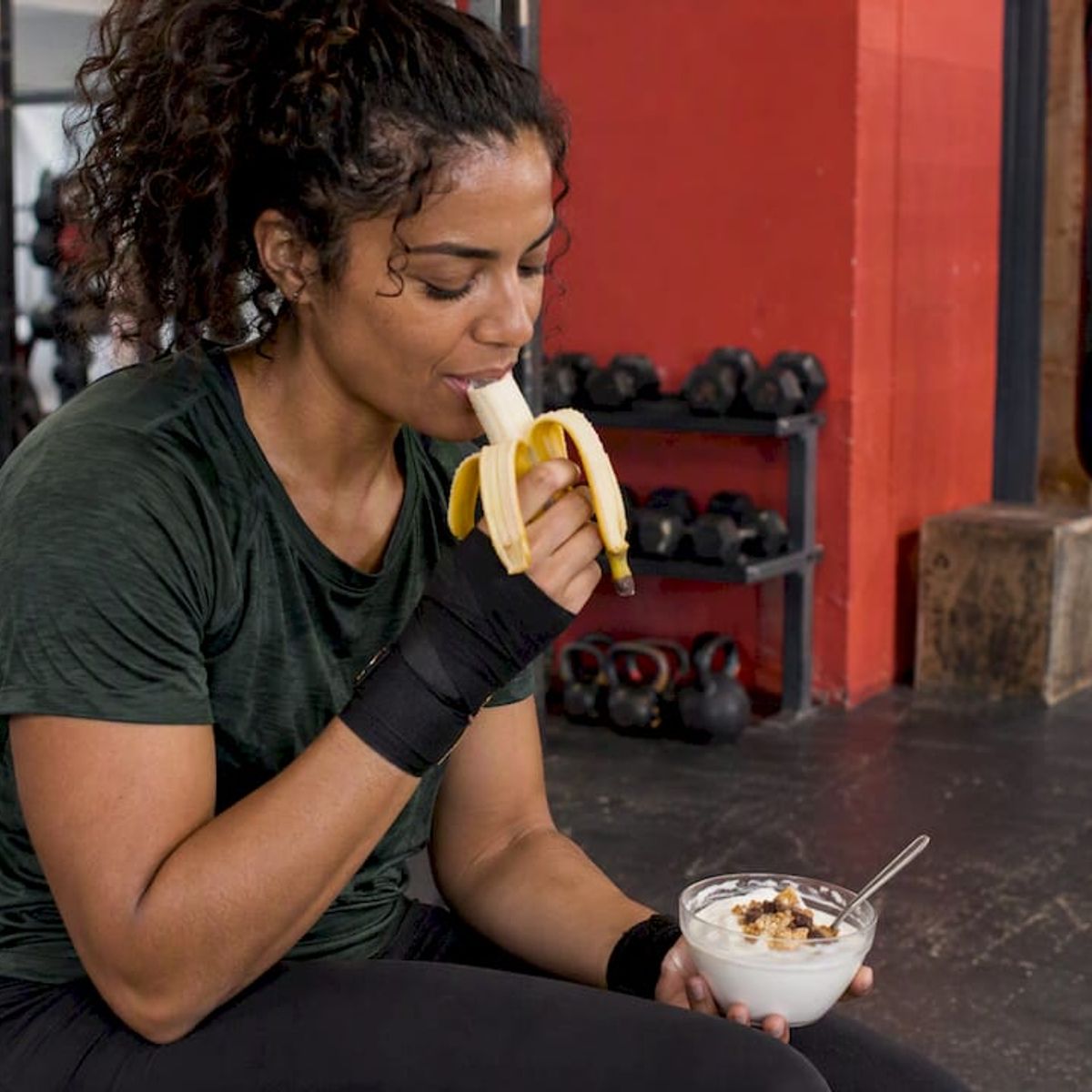
Experts note that beginners tend to overcomplicate this with pricey supplements. Everyday foods such as chocolate milk, Greek yogurt with berries, or a turkey sandwich give a balance of carbs and protein that works as well as commercial sports products for most people.
Grab-and-go (under 5 minutes)
- Chocolate milk and a banana
- Greek yogurt with berries and a handful of granola
- Turkey sandwich on whole-grain bread
- Peanut butter on toast with a piece of fruit
- Rice cakes with honey and a protein shake
Real meals (for when you get home)
- Chicken, white or brown rice and roasted vegetables
- Eggs, home fries or sweet potato, and fruit
- Burrito bowl with rice, beans and lean protein
- Pasta with ground turkey and tomato sauce
- Oatmeal made with milk, topped with berries and nuts
If you want a crunchy, portable protein option to carry in a gym bag, there are plant-based protein snacks built for after exercise. Pair one with a banana or a cup of rice and you’ve covered both sides: the snack for protein, the fruit or grain for carbs.
If mornings are your protein problem, our high-protein breakfast ideas are a good place to start. And if your week is packed, two 45-minute prep sessions can put post-workout meals in the fridge before you need them.
A few real-life schedules
These are examples, not prescriptions. Adjust them for your size, appetite and any medical conditions.
The student with a 7 a.m. lift and a 5 p.m. class. Two sessions, about 10 hours apart. Technically that’s outside the 8-hour window, but a solid breakfast with carbs and protein after the lift, then a real lunch, keeps you fueled for the afternoon. A cafeteria version: eggs, toast, fruit, then rice and chicken at lunch.
The commuter who trains at 6 p.m. and gets home at 8. Once-a-day training means total daily carbs are the priority. Have a banana and yogurt on the drive home if you’re starving, then a proper dinner. Nothing more complicated is needed.
The boxer doing two rounds of work in a day. Short turnaround, so lean on fast carbs: rice, potatoes, fruit and a protein source soon after the first session, repeated until the next one. Drink fluids too. Dehydration can happen during a single intense bout, so don’t count only on food.
The person cutting body fat. Keep carbs around training and trim them elsewhere, rather than skipping them after the session. Strong sessions are what protect muscle while you lose fat. Our piece on strength training and fat loss covers why.
Our take on post-workout carbs
At Level Up, we coach lifters, boxers and complete beginners, and the same pattern shows up in nutrition. People rarely fail because they ate rice at 7:40 instead of 7:10. They fail because they trained on almost nothing, skipped carbs out of fear, ate too little protein all day, or built a nutrition plan so strict it fell apart by Thursday.
So we keep it simple. First, we look at your whole day: sessions per week, sleep, protein, total food. Second, we put carbs where they help your training most, usually in the meal before and after. Third, we use ordinary food. Chocolate milk and a banana are fine.
If you box with us, you work hard. Our coaches include pro boxers, and a real boxing session is not a light cardio class. Fueling for it properly makes a visible difference in how the last rounds feel. If you’re a student on a budget or a commuter with no time, the best post-workout food is the one you will actually eat.
And if you’re unsure whether you’re under-eating, ask a coach. We would rather adjust a plan with you than watch you grind through flat workouts.
— Malcolm
Get a plan built around your training
If you’d like a written, individualized plan instead of guessing, that’s what we do. Every new member starts with a free class or consult, and we offer meal planning alongside coaching at our Stratford and Bridgeport locations. New to training? The 6-week Onramp is a structured way in, priced at $699 one-off, with coaching on both the training and the fueling. You can see all membership options, with no contracts, on our membership page.
Mistakes that undercut recovery
- Skipping carbs to “save calories.” Under-fueling hurts your next workout, which costs you more than the calories saved.
- Chasing the exact minute. If you train once a day, a meal within a couple of hours is fine.
- Buying supplements first. Food does the same job for most people, at lower cost.
- Forgetting sleep and rest. Food helps recovery, but it doesn’t replace it. Read our guide on the role of recovery in training.
- Ignoring the whole day. Our post on meal timing for workouts covers how to spread meals around sessions.
If you have diabetes, a kidney condition, a history of disordered eating, or any other medical condition that affects how you eat, talk with your doctor or a registered dietitian before changing your carb intake. The numbers above come from research on healthy, trained people.
FAQ
How soon after a workout should I eat carbs?
A snack or meal within 30 to 60 minutes is a common recommendation, especially after intense training. If you train once a day, a meal within a couple of hours works fine. The window only gets strict when your next hard session is less than 8 hours away.
How many carbs should I eat after a workout?
For a short turnaround between sessions, research suggests 1.0 to 1.2 g per kg of body weight per hour for the first 4 hours. For most people training once a day, that is far more than needed. Start with a normal portion of rice, potatoes, fruit or oats alongside protein, and hit your daily carb total.
Do I need protein with my post-workout carbs?
Yes, for muscle repair and growth. Protein doesn’t make glycogen refill faster, but it supports the muscle-building side of recovery. A simple pairing like Greek yogurt with berries covers both.
Are post-workout carbs bad for fat loss?
No. The carbs you eat after training are used mostly to refill the glycogen you burned. Cutting them out can leave you under-fueled and weaken the workouts that drive fat loss and strength.
Sources
- Nutritional Strategies to Improve Post-exercise Recovery and Subsequent Exercise Performance (PMC)
- Timing Your Pre- and Post-Workout Nutrition (Academy of Nutrition and Dietetics)
- How to Fuel Your Workout (Academy of Nutrition and Dietetics)
- Beginner’s Guide to Running Your Personal Best (Academy of Nutrition and Dietetics)
- Carbohydrate With and Without Protein and Muscle Glycogen Re-synthesis: Meta-analysis (PubMed)
- 9 Facts About Hydration & Electrolytes (ACSM)