Kettlebell Beginner Workout: A Simple 20-Minute Full-Body Plan
A good kettlebell beginner workout needs one bell, about 20 minutes and five basic moves: a deadlift, a goblet squat, a swing, an overhead press and a row. Do them as a circuit three times a week, keep every rep clean, and add weight or rounds only when the last session felt controlled. Below you will find how heavy your first kettlebell should be, how to do each move, the full circuit with sets, reps and rest, and a four-week plan to follow.
Level Up Gym
Build Strength With Coaching
Level Up Gym offers hybrid training and boxing in Stratford and Bridgeport, with coaching for beginners and adults pursuing strength or fat loss.
TL;DR
- Start with a bell you can press overhead for 8 reps without your form falling apart. ACE’s beginner guidance is 15 to 25 lb for men and 8 to 15 lb for women.
- Learn five patterns first: hinge, squat, swing, press and row. Form beats volume.
- A simple circuit is 3 rounds of deadlift, goblet squat, swing and press, 20 to 30 minutes with warm-up included.
- Train 2 to 3 days a week with a rest day between sessions, and progress one variable at a time.
- Kettlebells support fat loss as part of a calorie deficit and regular activity. They do not spot-reduce belly fat.
Table of Contents
- How heavy should your first kettlebell be?
- The five moves to learn first
- Warm up first: five minutes, no skipping
- The beginner kettlebell circuit
- How long should a beginner kettlebell workout be?
- How often to train and how to progress
- Can kettlebells help you lose belly fat?
- Who should check with a professional first
- Our perspective: coaching beats a perfect program
- Want a coach to check your form?
- FAQ
- Sources
How heavy should your first kettlebell be?
This is the question that decides whether your first month is productive or frustrating. Too light and the swing turns into an arm lift. Too heavy and your lower back pays for it.
The American Council on Exercise suggests 15 to 25 lb (7 to 11 kg) for men and 8 to 15 lb (4 to 7 kg) for women who are new to resistance training. Women’s Health, for its part, says beginners can start with 5 to 10 lb depending on the exercise. Those ranges overlap because the right weight depends on the move.
A practical way to choose:
- Swings and deadlifts (big hip muscles): the heavier end of your range.
- Goblet squats: the middle of your range.
- Overhead presses and rows (smaller muscles, one arm at a time): the lighter end.
If you can only buy one bell, pick the weight you can press overhead for 8 clean reps with each arm, then use it for everything. You will have a lot of room to grow with it, because slower tempo, pauses and more reps make the same bell harder. If you have access to a gym with a rack, you can borrow two or three sizes and skip the guessing.
Your bell should have a smooth, wide handle you can hold without it digging into your palm. A flat base helps for deadlifts and rows.
The five moves to learn first
BarBend’s advice for beginners is to start light and learn the movement pattern before chasing load. It also says that if your form is not crisp, you should scale back or use a modification. We agree with both. Spend your first two sessions on the moves below, with fewer reps than the circuit asks for.
Kettlebell deadlift
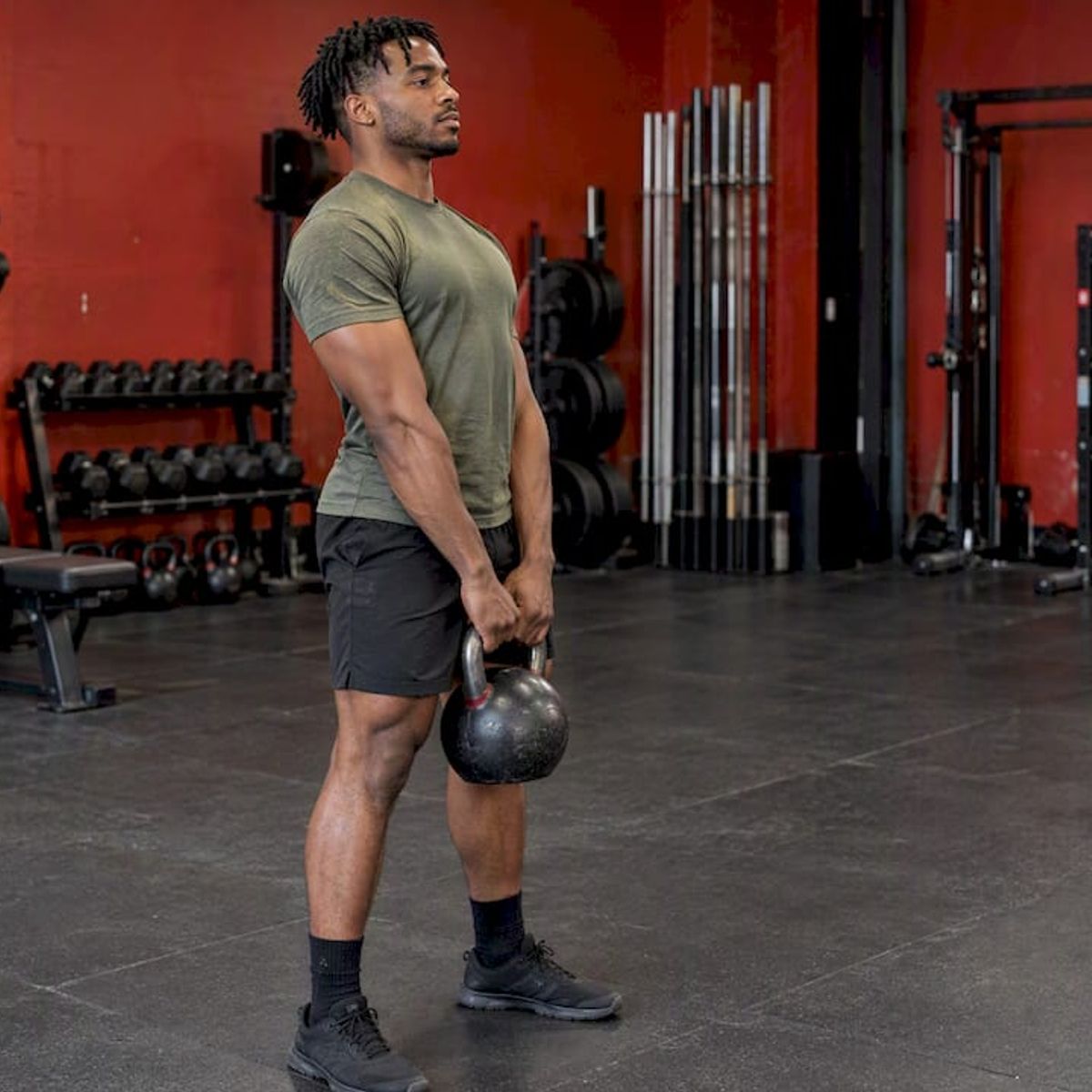
Stand with feet about shoulder-width apart and the bell between your feet, just ahead of your ankles. Push your hips back like you are closing a car door with your backside, let your torso tilt forward with a flat back, and grip the handle with both hands. Stand up by driving your feet into the floor and squeezing your glutes at the top. Do not round your upper back to reach the bell. If you cannot reach it without rounding, raise the bell on a block or a short stack of books.
This is the foundation of the swing, so a solid hinge here pays off later.
Goblet squat
Hold the bell upside down by the horns, close to your chest, elbows pointing down. Feet are a little wider than your hips, toes turned slightly out. Sit between your hips, keeping your chest tall, and go as deep as you can while your heels stay down. Stand up by pushing the floor away. The weight in front acts as a counterbalance, which is why many people find their squat suddenly gets deeper and more upright.
Two-hand swing
The swing is a hinge, not a squat and not an arm raise. Set the bell about a foot in front of you. Hike it back between your legs like a football snap, then snap your hips forward so the bell floats to chest height. Your arms are just hooks. At the top you should be standing tall with glutes tight, not leaning back. Let the bell fall and hinge again as it passes your hips.
If the bell is pulling you forward on the way down, or your lower back is doing the work, go back to the deadlift and drill the hinge again. A study comparing swings with treadmill running found that a 10-minute swing routine provided enough exercise stress to improve aerobic capacity, which is one reason swings earn their place in short workouts.
Single-arm overhead press
Clean the bell to the rack position (resting against your forearm and chest, wrist straight), squeeze your glutes and press straight up until your biceps are near your ear. Keep your ribs down so you do not arch your back. Lower under control. Start with the bell in the rack and no swing or cleaning at first: lift it with both hands to your shoulder if needed.
BarBend recommends using an offset grip, sometimes called the motorcycle grip, to keep the wrist neutral on moves like snatches. For presses, the same principle applies: a stacked wrist over the forearm, not bent back.
Bent-over or split-stance row
Hinge forward with a flat back, bell hanging in one hand, free hand on your thigh or a bench. Pull the handle to your hip, leading with your elbow, then lower it fully. This move balances all the pushing and squatting, and it builds the grip and upper back that make swings and carries feel easier.
For a closer look at how simple tools can still build real strength, see our piece on building strength with limited equipment.
Warm up first: five minutes, no skipping
Kettlebells reward warm joints. A five-minute routine is plenty:
- 30 seconds of marching or easy jumping jacks.
- 8 hip hinges with no weight, pausing at the bottom.
- 8 bodyweight squats, slow.
- 6 slow arm circles each direction, then 8 wall or floor push-ups.
- 5 “halos” with the bell around your head, each direction, if the weight is comfortable.
The point is to rehearse the hinge and squat before you load them.
The beginner kettlebell circuit
This is a full-body kettlebell circuit built on a pattern a US company published for beginners: deadlift, goblet squat, two-hand swing and single-arm overhead press, three rounds, with 30 seconds of rest between exercises and 60 seconds between rounds. We have added a row so the workout pulls as well as pushes.
OrderExerciseRepsNotes
1
Kettlebell deadlift
10
Slow lowering, flat back
2
Goblet squat
10
Heels down, chest tall
3
Two-hand swing
15
Hips drive the bell
4
Single-arm overhead press
8 per arm
Glutes tight, ribs down
5
Bent-over row
8 per arm
Pull to the hip
Rest: 30 seconds between exercises, 60 seconds between rounds (or 90 if you are still learning the moves). Rounds: 3.
The total time is about 15 to 18 minutes of work. Add the warm-up and a cool-down and you are at 25 minutes or a little less.
Other published beginner circuits are in the same neighborhood. Women’s Health suggests three to four moves, 8 to 10 reps each, three rounds, and BarBend notes that kettlebell instability already makes training challenging, so there is no need to pile on volume or complexity. If something here feels like too much, cut a round before you cut your form.
A quick cool-down
Spend two to three minutes walking, then stretch your hip flexors, chest and calves for 20 to 30 seconds each. Nothing fancy.
How long should a beginner kettlebell workout be?
Short is fine, and short is how most people stay consistent. The New York Times published a full-body kettlebell workout of about 15 minutes that can be adapted to different levels, done for three rounds. A kettlebell company’s coaching notes recommend 20 to 30 minutes in total for beginners, with a five-minute warm-up, 12 to 18 minutes of work and a three-to-five-minute cool-down.
So, is a 20-minute kettlebell workout effective? For a beginner, yes, provided the effort is real and the form is clean. Swings, squats and presses use large muscle groups, and the 10-minute swing study above suggests short blocks can be demanding enough to matter. What counts is whether you repeat it each week and progress over time.
How often to train and how to progress
Most beginners do best with two or three sessions a week and a rest day between them. Women’s Health calls three times per week a reasonable starting point, with recovery days between weight sessions. Research agrees that less can work: a Journal of Strength and Conditioning Research study found that six weeks of kettlebell training twice a week improved strength and power in healthy young men. That study was in men, so treat it as encouraging rather than a promise.
A simple four-week path:
WeekSessionsRoundsChange
1
2
2
Learn the moves, longer rest (90 seconds between rounds)
2
3
3
Use the standard rest from the table
3
3
3
Slow the lowering on deadlifts, squats and presses to 3 seconds
4
3
3 to 4
Add 2 reps per exercise, or a fourth round in one session
Change only one thing at a time. When the top of your rep range feels easy for two sessions in a row, move to the next bell size, or add reps first if the jump is too big. If you have two or three more weeks to give, this structure also fits nicely with our six-week beginner fitness plan, which puts movement quality first.
Signs you should back off
- Your lower back aches the next day after swings or deadlifts, not just your glutes and hamstrings.
- The bell bangs your forearms on swings.
- Your reps slow down and your form changes by round three.
Any of these is a cue to drop the weight, shorten the rounds or return to the deadlift and goblet squat for a session or two.
Can kettlebells help you lose belly fat?
They can help you lose fat overall, and your body decides where it comes from. The CDC says most weight loss comes from eating fewer calories, and that being active on top of that helps create a calorie deficit. It also advises adults to get at least 150 minutes of moderate aerobic activity (or 75 minutes of vigorous activity) a week plus two days of muscle-strengthening work.
A three-day kettlebell routine covers the muscle-strengthening part with room to spare, and the swing-heavy circuits raise your heart rate. Walking, cycling or boxing can make up the rest of your weekly activity. If fat loss is your main goal, these pages are a good next step:
- The role of strength training in fat loss
- Why muscle matters for fat loss
- Our calorie deficit calculator, to set a safe target
Who should check with a professional first
If you have a history of back, shoulder or wrist pain, are pregnant or postpartum, have heart disease or high blood pressure, or have not exercised in a long time, talk to your doctor or a physical therapist before you start swinging. If you have osteopenia or osteoporosis, read up on osteoporosis exercise guidelines first and check with your clinician, because loaded hinging and fast swings are not right for everyone. Stop any exercise that causes sharp, pinching or radiating pain, and have it looked at.
Our perspective: coaching beats a perfect program
People come to us after trying a handful of YouTube kettlebell routines. The routine is rarely the problem. What goes wrong is that nobody watched the hinge, nobody changed the weight when the form slipped, and nobody said “stop at round two today.”
That is why we keep classes capped in size, so a coach can see every rep, and why the coaches at Level Up Gym are certified, including pro boxers who know how much posture and hip power matter. We start every new member with a free class or consult and a written, individualized plan, because a plan that fits your schedule and experience is the one you will actually follow. Beginners are our priority, and our memberships have no contracts, so you can try it and see.
Our advice for your first month is plain: pick a moderate bell, film one set of swings from the side, and compare it with a coach or a trusted reference. If your hips are doing the work and your back is neutral, you are on the right track. If not, slow down. Strength builds on good movement, which we explain in what functional fitness is and why it matters.
— Malcolm
Want a coach to check your form?
If you live near Stratford or Bridgeport, Connecticut, you can have a certified coach watch your hinge, squat and swing before you build habits that are hard to undo. Our large group classes run from $24.99 to $59.99 per week, and small-group personal training for 2 to 4 people runs from $74.99 to $174.99 per person per week. If you want a structured start, the 6-Week Onramp is a $699 one-off program for beginners. Not sure yet? Start with the free class or consult.
FAQ
What kettlebell weight should a beginner use?
ACE’s guidance for beginners is 15 to 25 lb for men and 8 to 15 lb for women, with lighter bells for presses and rows. Choose a weight you can press overhead for 8 clean reps per arm. If your form changes during a set, the bell is too heavy for that move.
How many days a week should I do a kettlebell workout?
Two to three non-consecutive days is a good range for beginners. Start with two if you are new to lifting, then move to three once you are recovering well. Leave at least a day between sessions.
Can I do a kettlebell workout every day?
It is better not to at first. Your muscles, grip and lower back need time to adapt to swings and deadlifts. On off days, walk, stretch or do light mobility work.
Are kettlebells better than dumbbells for beginners?
Neither is better outright. Dumbbells are easier for presses and rows, while kettlebells suit swings and goblet squats because of the offset weight and the handle. A single kettlebell is enough to start with, and it is easier to store.
Is a kettlebell workout enough to lose weight?
It helps, but fat loss mostly comes from a calorie deficit, as the CDC explains. Combine two or three kettlebell sessions with daily walking and sensible eating, and see our guide to nutrition in training for a starting point.
Sources
- Kettlebell Workout: 7 Kettlebell Exercises for a Full-Body Workout (Healthline)
- The Complete Guide to Kettlebell Training for Beginners (BarBend)
- The Best Full-Body Kettlebell Circuit Workout (BarBend)
- Beginner Kettlebell Workout: 15-Minute Full-Body Circuit (BodySpec)
- A 15-Minute Full-Body Kettlebell Workout (The New York Times)
- 16 Best Kettlebell Exercises For Women (Women’s Health)
- Beginner Kettlebell Session Length: 20 to 30 Minutes (Raw Kettlebell)
- Comparison of Kettlebell Swings and Treadmill Running (Journal of Strength and Conditioning Research, 2012)
- Effects of Weightlifting vs. Kettlebell Training (Journal of Strength and Conditioning Research, 2012)
- Physical Activity and Your Weight and Health (CDC)