Boxing Training at Home: A Beginner’s Plan That Works
You can build real boxing fitness at home with a little floor space, a pair of hand wraps and a plan. Start with shadowboxing and footwork, add a heavy bag once your technique holds up, and bring in a coach to check what you can’t see yourself. This guide covers the gear, the bag weight, the drills, the combos and a weekly schedule, and it is honest about where home training stops working.
Level Up Gym
levelupgym.app
Build Boxing Skills With Coaching
Level Up Gym offers boxing training in Stratford and Bridgeport, with beginners welcome as they build skill beyond home practice.
TL;DR
- Start with shadowboxing, footwork and a jump rope. Add a heavy bag only after your basic punches look clean on video.
- For a hanging heavy bag, many coaches suggest about half your body weight, and heavier if you are unsure.
- Aim for the CDC’s weekly targets: 150 minutes of moderate activity or 75 vigorous, plus 2 days of muscle strengthening.
- Home training is great for conditioning. It is weak on correction, so book a coached session now and then.
- Check in with a healthcare provider first if you are new to exercise or returning after a long break.
Table of Contents
- What you can learn at home, and what you can’t
- Check your starting point first
- The gear you need, in order
- Heavy bag weight: how to choose
- Why the heavy bag comes later
- A warm-up that takes 10 minutes
- Home boxing drills for beginners
- Beginner combos for the heavy bag and shadowboxing
- A first-month weekly plan
- Filming yourself and staying consistent
- Avoiding injuries
- Our perspective on training boxing at home
- When a coach is worth it
- FAQ
- Sources
What you can learn at home, and what you can’t
You can learn the shape of boxing at home: stance, jab, cross, hook, uppercut, basic footwork and a sound defensive posture. You can build the engine too. Rounds of shadowboxing, rope work and bodyweight conditioning get your heart rate up fast.
What you can’t get is someone watching your feet. What feels like perfect form is often not, especially footwork and punch alignment. A coach spots a dropped guard, a flat-footed cross or a wrist bending on impact in seconds. At home, you catch those only if you film yourself and compare against good footage.
That is not a reason to wait. It is a reason to treat home training as practice for what you learn from a coach, and to build in ways to get feedback.
Check your starting point first
Boxing-style training is demanding. Research on simulated three-round bouts in elite boxers found heart rates often above 90% of maximum. You won’t train like that in week one, and you shouldn’t.
The American Heart Association advises people who are new to exercise or returning to it to talk with a healthcare provider and start at light-to-moderate intensity. If you have a heart condition, joint problems, a past wrist or shoulder injury, or you are pregnant, ask your doctor or physical therapist which movements are safe for you before you start.
For intensity, use how hard it feels instead of a heart-rate number. Rate effort from 1 to 10. Most of your first month should sit around 5 to 7, with a few rounds that touch 8. If your form breaks down, the round is over, however much time is left.
The gear you need, in order
You don’t need a garage gym. Buy in this order and stop whenever the plan is working.
- Space. About a 6 by 6 foot clear area, a ceiling that clears your raised arms, and a floor that isn’t slick. Shoes with grip help. Barefoot on hardwood is a slipping risk.
- A jump rope. It builds the footwork rhythm and the calf endurance that boxing rewards.
- Hand wraps. They support the small bones of the hand and the wrist. We explain how to choose and wrap them in our guide to 180-inch Mexican-style hand wraps.
- A mirror or phone stand. Mirrors show your guard. A phone shows everything else.
- Gloves and a heavy bag. Only after steps 1 to 4 feel routine.
On cost, the equipment is the smaller part of it. For a sense of the range, USA Boxing’s fitness membership is listed at $35 per year. It is for non-contact training in registered gyms and doesn’t cover sparring or competition.
Heavy bag weight: how to choose
This is the question behind “what weight heavy bag” and “punching bag weight.” A common rule of thumb among coaches is a hanging bag at roughly half your body weight. A 160-pound adult would look at about 80 pounds, and a 200-pound adult at about 100.
Two cautions for beginners:
- Too light is the bigger mistake. A light bag swings, rewards sloppy hitting and puts more stress on your wrists. If you are between sizes, go heavier.
- Check what you can hang it from. An 80 to 100 pound bag needs a joist or a rated stand. Hanging it from drywall anchors is how bags end up on the floor, and sometimes on a foot.
Freestanding bags are easier in apartments, but they move differently and can skid. If you rent, a freestanding bag on a rubber mat is often the practical choice. Whatever you buy, check the manufacturer’s weight and mounting instructions.
Why the heavy bag comes later
Most beginners buy a bag first and hit it hard. That’s backwards. A study comparing pad-based and bag-based boxing training in the Journal of Strength and Conditioning Research looked at how the body responds to each. The practical read is that the bag is harder on joints, particularly wrists and shoulders, while pads tend to push the heart and endurance harder.
So, in your first weeks, build the heart rate with shadowboxing, rope work and bodyweight rounds. Let your wrists and shoulders adapt gradually. Add bag rounds at 50 to 60 percent effort first, and keep your wrists straight at impact. Our shadowboxing guide is the best place to build the base.
A warm-up that takes 10 minutes
Cold shoulders and stiff ankles are where beginners get hurt. Spend 10 minutes before every session on:
- Easy rope or marching in place, 2 minutes
- Arm circles, shoulder rolls and thoracic rotations, 2 minutes
- Bodyweight squats and lunges, 2 minutes
- Ankle and hip mobility, 2 minutes
- One light shadowboxing round, 2 minutes
For more options, see our boxing warm-up drills and the power and speed warm-up. Some people also use a vibration plate to prime before training. If that is you, this vibration plate pre-workout protocol explains one way to do it. It is an extra, not a requirement.
Home boxing drills for beginners
These are the drills that carry the most value per minute. Each round is 2 to 3 minutes with 30 to 60 seconds of rest.
Stance and jab
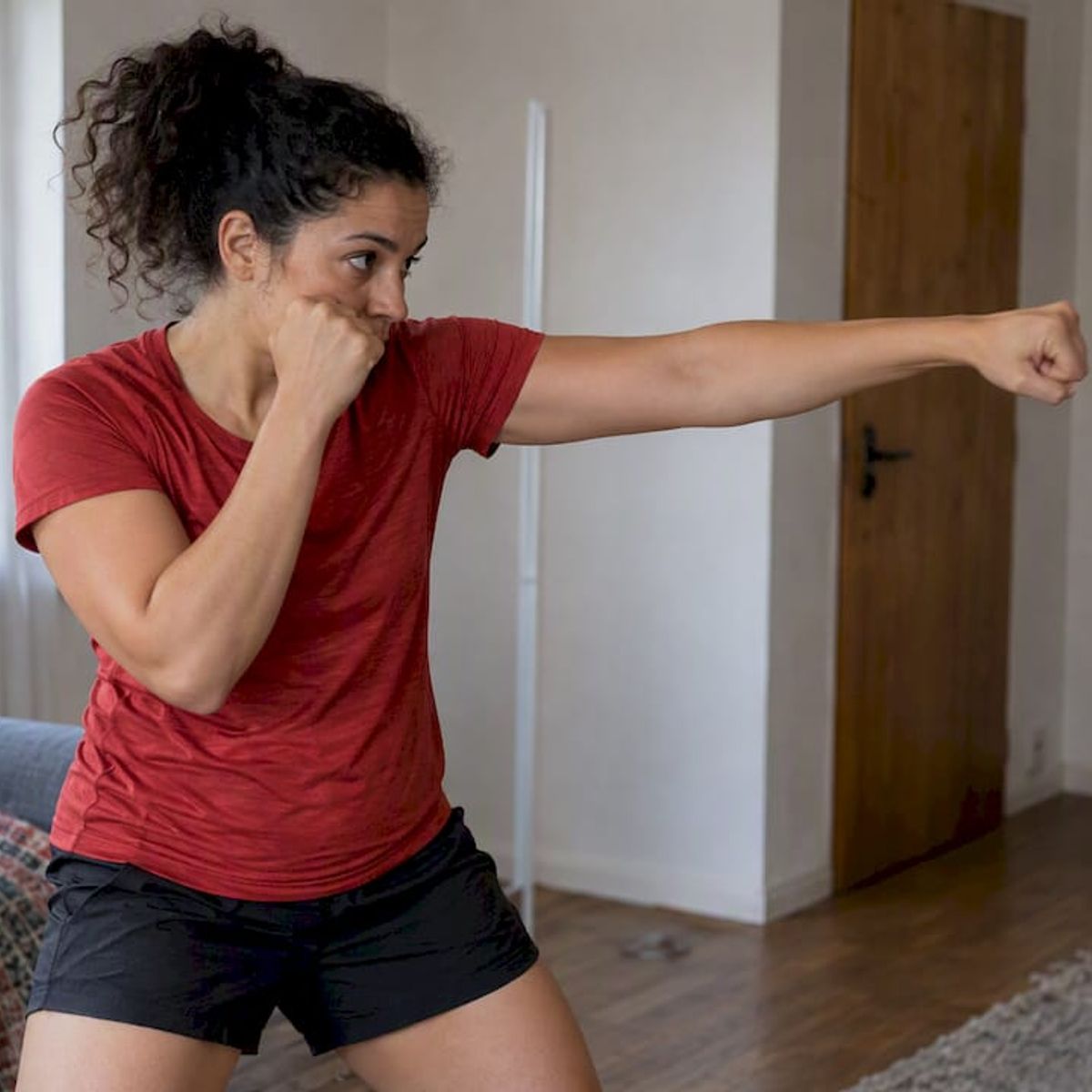
Stand with your feet a little wider than your shoulders, lead foot forward, rear heel slightly lifted. Hands up by your cheeks, chin down. Throw only the jab for a full round, slowly, and return the hand to your face every time. Speed comes after the shape is right.
Footwork
Step forward, back, left and right without crossing your feet or letting them drift together. Keep your weight on the balls of your feet. Footwork is where most home boxers are weakest, so give it its own round. Our footwork drills go further.
Shadowboxing with a purpose
Pick one job per round: stay balanced, keep the guard up, move your head after each combo, or breathe out on each punch. A round with a single focus teaches more than three rounds of flailing.
Rope and bodyweight finishers
Two rounds of rope and a short circuit of squats, push-ups and planks fill out the session. This is also your muscle-strengthening work. The CDC says strengthening should reach the point where another repetition would be hard to do without help.
Beginner combos for the heavy bag and shadowboxing
Boxers number punches: 1 is the jab, 2 is the cross, 3 is the lead hook, 4 is the rear hook, 5 is the lead uppercut and 6 is the rear uppercut. Some gyms swap the uppercut numbers, so go with your coach’s system if you have one.
ComboPunchesWhat it teaches
1-2
Jab, cross
Straight lines, hip rotation
1-1-2
Double jab, cross
Rhythm, setting up power
1-2-3
Jab, cross, lead hook
Weight shift, short hook
1-2-slip-2
Jab, cross, slip, cross
Defense into offense
1-2-3-2
Jab, cross, hook, cross
Flow, recovering your guard
2-3-2
Cross, hook, cross
Power sequences
On the bag, pair each combo with a step in and a step out. Hit, move, reset. Standing still and trading punches with a bag is the habit coaches spend months undoing.
A first-month weekly plan
Three sessions a week is enough. Our guide on how often to box covers this by goal.
DaySessionTime
Mon
Warm-up, stance and jab rounds, footwork, rope
30 min
Wed
Warm-up, shadowboxing with one focus per round, bodyweight strength
30 min
Fri
Warm-up, combos on the bag or in the air at 50 to 60 percent, rope finisher
30 to 35 min
If you want more detail on the structure, our four-week boxing plan without sparring lays it out. Each week, add one round or a little more crispness, not both.
For your overall health, three 30-minute sessions get you close to the CDC’s aerobic target if the effort is vigorous. On the CDC’s scale, 1 minute of vigorous activity counts as roughly 2 minutes of moderate. Add walking and your 2 strength days and you are in range.
Filming yourself and staying consistent
Record one round from the side and one from the front each week. Look at three things: does your rear hand return to your chin, are your feet staying a shoulder width apart, and is your head moving off the line after punches? Compare with clips of good technique and fix one item at a time.
The other problem is not skill but showing up. ACSM’s home gym guidance points to the appeal of training at home, and in practice the weak point is accountability. A training partner, a scheduled slot in your calendar or a coach checking in makes solo sessions much more likely to happen.
Avoiding injuries
Pushing through broken form is how beginners end up sidelined. The same elite-boxer research on internal training load makes the point that how hard the session feels matters, not just how much you did. In practice:
- Stop a round when your guard drops or your wrists bend.
- Wrap your hands every time you hit a bag.
- Take wrist or shoulder pain seriously. Rest, and see a physical therapist or doctor if it lingers.
- Skip sparring entirely at home. Boxing fitness doesn’t need it.
Our injury prevention templates give two starter routines. If you are over 50, start with the 20 to 25 minute plan for adults 50+. To support your punching, strength training for boxing shows how to use weights without overdoing it.
Our perspective on training boxing at home
We see two kinds of people walk into our gyms in Stratford and Bridgeport. Some have never touched a bag. Others have spent months with a bag in the basement and a handful of videos, and they come in tired, a bit sore in the wrists and unsure whether they are doing it right.
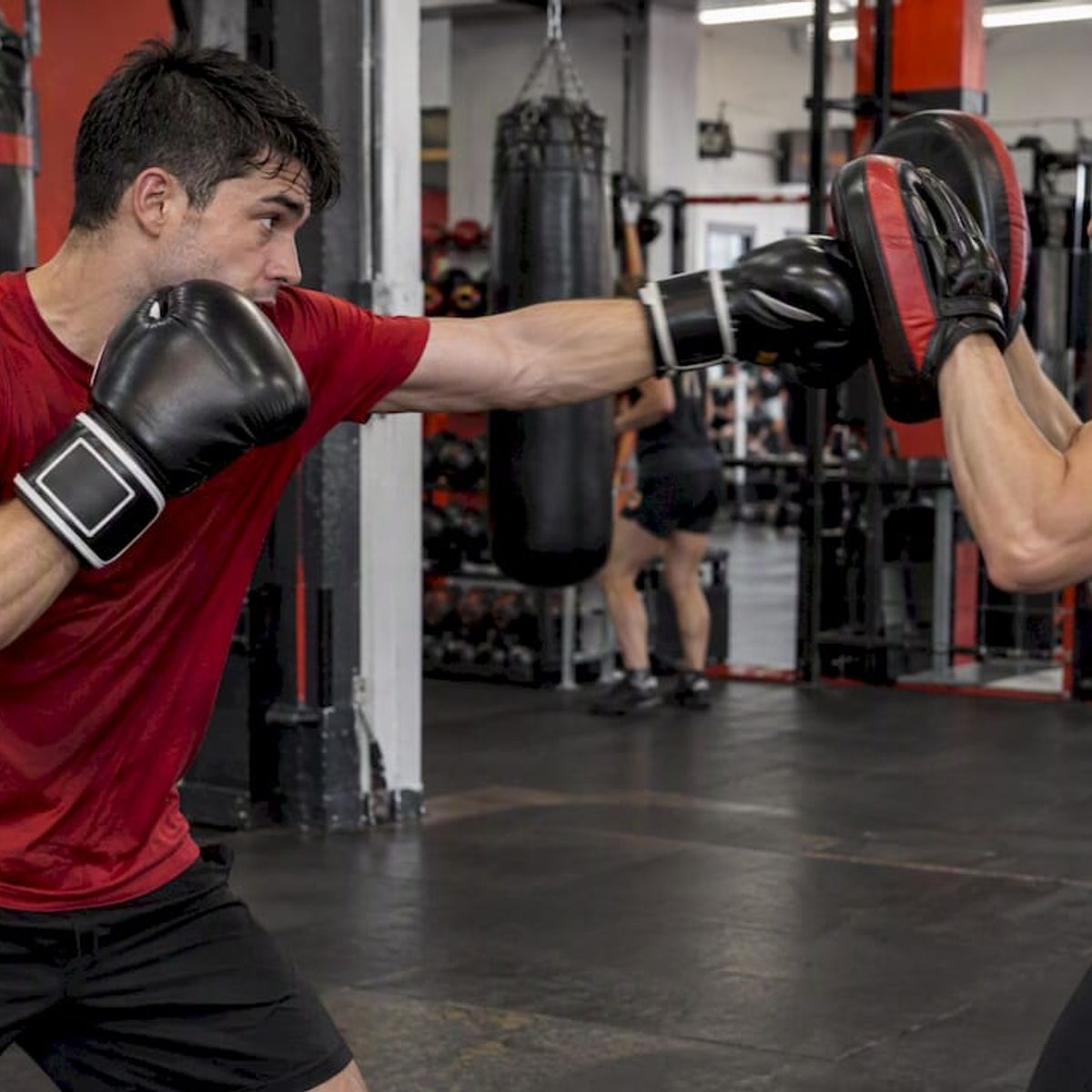
The second group almost always has the fitness. What they lack is feedback. Their guard drifts, their back foot is planted, and nobody has told them. A coach can fix that in one session, and that’s the part we believe in most. Our classes are capped in size, led by certified coaches including pro boxers, and we teach real boxing, not cardio boxing. Beginners are the priority, and there are no contracts.
Our advice: use home training for volume and coached sessions for correction. Do both and you progress faster than with either alone.
— Malcolm
When a coach is worth it
Home training gets you started. A coach gets you right. If you live near Stratford, Bridgeport, Fairfield, Milford or nearby, these are the options we offer:
- Free boxing class in Stratford: every new member starts with a free class or consult and a written, individualized plan.
- Boxing classes: coached rounds on bags and pads with technique corrections built in.
- 6-Week Onramp: a structured start for beginners, $699 one-off.
- Large group classes: $24.99 to $59.99 per week. Small group training (2 to 4 people) runs $74.99 to $174.99 per week per person, and 1-on-1 personal training $149.99 to $359.99 per week.
- Online training: remote coaching if you can’t make it to a gym but want someone watching your form and plan.
Not sure where you fit? Start with the free class and bring your questions.
FAQ
Can you learn proper boxing at home?
You can learn the basics: stance, punches, footwork and conditioning. What’s hard to learn alone is correction, because you can’t see your own errors well. Film yourself, and get a coach to review your technique now and then, in person or online.
Is 25 too late to learn boxing?
No. If your goal is fitness, skill and confidence, 25 is a fine age to begin, and many adults start much later. Fitness-focused boxing doesn’t require sparring. Start with light intensity and build gradually, and ask a healthcare provider first if you have any health concerns.
How much does it cost to train for boxing?
At home, the basics are hand wraps, a jump rope and space. Add gloves and a bag when you are ready. For coaching, a USA Boxing fitness membership is $35 per year, and at our gyms, large group classes run $24.99 to $59.99 per week.
Can boxing be used as a workout?
Yes. Boxing-style training can count toward both aerobic and muscle-strengthening goals if the intensity is high enough. A pilot study in adults with abdominal obesity found high-intensity boxing training to be feasible. Start low, progress slowly and use effort rating rather than chasing a heart-rate number.
Sources
- CDC: Adult Activity Overview
- USA Boxing: Fitness Membership
- Cardio-respiratory responses to a simulated 3 x 3 minute amateur boxing contest (PMC)
- American Heart Association: Develop a physical activity plan
- Physical response to pad- and bag-based boxing training (PubMed)
- ACSM: 3 Essentials for Building a Home Gym
- High-intensity boxing training in adults with abdominal obesity: a pilot study (PMC)