Foam Roller Routine for Beginners: A 10-Minute Plan
A good beginner foam roller routine is short: a soft, smooth roller, six major muscle groups, about 30 to 60 seconds on each, slow passes and steady breathing. Aim for under 10 minutes, two or more times a week. Roll before training to feel looser, then follow it with an active warm-up. Roll after training to ease soreness. If you want a coach to show you the movements in person, our 6-Week Onramp is built for beginners.
Level Up Gym
Build Confidence With Coached Training
Level Up Gym offers hybrid training and boxing in Stratford and Bridgeport, with beginners welcome and no contracts.
TL;DR
- Start with a soft, smooth roller. Harvard Health suggests moving to a firmer one only as your tissues adapt.
- Roll each muscle group for about 30 to 60 seconds, slowly, at least twice a week.
- Keep the roller on muscle, never on bone, joints or your lower back.
- Rolling is preparation or recovery, not training. Follow it with an active warm-up before lifting or boxing.
- Sharp pain, numbness, tingling or swelling means stop and see a doctor.
Table of Contents
- What foam rolling does (and what to expect)
- Choose the right roller
- The basic technique
- A 10-minute beginner routine
- How to foam roll your legs
- Before or after your workout?
- How often to roll
- Where not to roll, and when to stop
- Common beginner mistakes
- Our perspective
- Take the routine into a coached session
- FAQ
- Sources
What foam rolling does (and what to expect)
Foam rolling is a form of self-massage. You use your body weight to press a cylinder of firm foam into a muscle and roll slowly over it. Clinicians call it self-myofascial release, meaning pressure on the muscle and the connective tissue around it.
Cleveland Clinic lists easing muscle soreness, increased range of motion and blood flow, and a sense of recovery and relaxation among its benefits. A 2020 meta-analysis found a large, immediate improvement in range of motion (effect size 0.76). It also supported a daily bout of rolling the lower limbs for up to 72 hours after hard, muscle-damaging exercise to lower soreness and the dip in power and speed.
Keep expectations realistic. Exercise scientist Ken Nosaka, writing in The Conversation, summarized a review of 21 studies: pre-exercise rolling improved flexibility by about 4%, and the range-of-motion gains last roughly 20 minutes. That is exactly why rolling works best as a quick primer before a warm-up, not as a workout in itself. Cleveland Clinic also notes there is no real evidence that rolling improves cellulite.
Choose the right roller
For a first roller, pick a lightweight, smooth one. HSS recommends a softer, smooth, longer roller for beginners because it is more stable. Textured or very firm rollers dig in harder and are better saved for later, once the smooth one feels easy.
A roller about 36 inches long gives you room for your back and legs. A shorter one travels well in a gym bag or a dorm room.
The basic technique
Three rules cover most of it:
- Go slow. NASM’s calf guidance puts the pace at about one inch per second. The NSCA calls rolling too fast over sensitive areas the most common mistake.
- Use moderate pressure. USC’s FitnessU describes the right feel as comfortably uncomfortable. Discomfort is fine. Sharp pain is not.
- Keep breathing. Holding your breath is a sign you are pressing too hard. ACTIVE.com advises reducing pressure or stopping if you catch yourself doing it.
When you find a tender spot, pause on it for a few extra seconds with deep breaths, as HSS suggests, then keep rolling.
A 10-minute beginner routine
Harvard Health suggests about 30 to 60 seconds per muscle group. Cleveland Clinic’s clinician suggests keeping the whole session under 10 minutes. Here is a plan that fits both. Do each move for about 45 seconds, switching sides halfway where it applies.
OrderAreaTimeCue
1
Calves
45 sec per leg
Roll from above the ankle to below the knee
2
Hamstrings
45 sec per leg
Just above the knee toward the glutes
3
Quads
45 sec per leg
Face down, from above the knee to the top of the thigh
4
Outer thigh
15 to 30 sec per side
Lie on your side, hip to just above the knee
5
Glutes
45 sec per side
Sit on the roller, cross one ankle over the opposite knee
6
Upper back
45 sec
Arms crossed, roll between the shoulder blades and mid-back
That adds up to roughly 8 to 9 minutes with transitions. Do one pass through the list, or two quicker passes if you have time. USC’s guidance is to complete each exercise briefly and then repeat the full cycle.
How to foam roll your legs
Legs are where most beginners start, so here is the detail, based on the Mayo Clinic handout.
Calves
Sit with the roller under your lower calf and hands behind you. Lift your hips and roll from just above the ankle to just below the knee. Stack one leg over the other for more pressure once the single-leg version feels easy.
Hamstrings
Sit with the roller under the back of your thigh, hands on the floor. Roll from just above the knee toward the glutes, keeping your spine neutral.
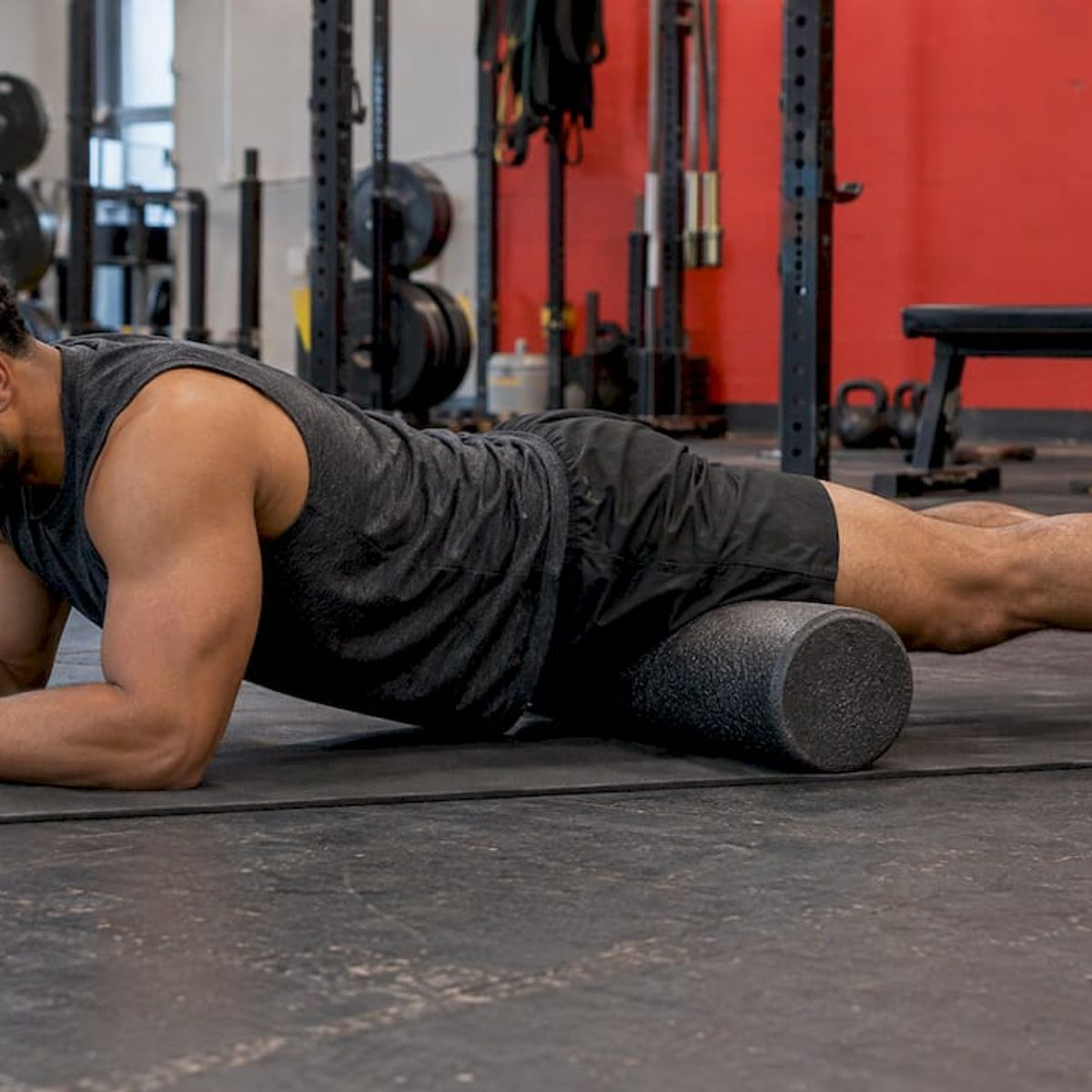
Quads
Lie face down with the roller under your thighs, forearms on the floor. Roll from just above the knees to the top of the thighs. Do not let your lower back sag.
Outer thigh
Lie on your side with the roller under the outer thigh, using your elbow and the opposite foot for support. Roll from just below the hip to just above the knee. This area is often the most tender. ACTIVE.com suggests starting with 10 to 15 seconds and building to 30 seconds over later sessions.
On the IT band: a tight outer thigh can feel better after rolling, but Princeton Sports and Family Medicine notes rolling does not break up the band or permanently lengthen fascia. Treat it as a way to ease tension, and go gently.
Before or after your workout?
Both work, for different jobs.
Before: a short bout (90 to 120 seconds total per area is the range a 2020 review of 49 articles pointed to) can leave you feeling less stiff. Then do an active warm-up. Princeton’s Dr. Peter Wenger frames the order as roll briefly, feel looser, warm up actively, then train. If you box, our boxing warm-up guide shows what that warm-up looks like. Lifters can use our 12-minute mobility routine.
After: a 2019 review of 22 studies found the best-supported benefit is short-term relief of soreness, with about 90 seconds per muscle appearing useful. If you are sore after a hard leg day, rolling the next day or two can help. Our guide to managing workout soreness covers the rest of the recovery picture: sleep, food and easy movement.
Rolling versus stretching? A 2019 study in Medicine & Science in Sports & Exercise found similar ankle-flexibility gains from either, with no extra benefit from doing both. Pick the one you will actually do.
How often to roll
Harvard Health says at least twice a week, three to five rounds per muscle group, and daily rolling may bring more benefit. USC suggests two 15-minute sessions a week. Start with two or three short sessions, tied to days you train, and add more only if it feels good. If you build rolling into your recovery habits, a broader daily recovery routine can help you plan the rest of your week.
Where not to roll, and when to stop
The safety rules are simple and worth following every time:
- Stay off bone and joints. Harvard Health’s Dr. Ahmed explains the biggest concern is rolling over bone, so avoid knees, pelvis and shoulder blades. Cleveland Clinic warns that rolling on ankles, knees or elbows can cause hyperextension. Skip the lower back too.
- Avoid aggressive rolling over acute injuries, fractures, open wounds, significantly inflamed tissue or a suspected blood clot, per Princeton Sports and Family Medicine.
- Talk to a doctor first if you have a broken bone or torn muscle, are pregnant, or have a heart or vascular illness or chronic pain condition (Cleveland Clinic, USC).
- See a doctor if you have pain that interferes with daily life, tingling, numbness, weakness, or a sudden increase in pain or swelling, according to HSS.
Persistent focal pain is something to get checked, not something to roll out.
Common beginner mistakes
- Rolling too fast, which gives your muscles no time to relax.
- Pressing as hard as possible. Moderate pressure works better than painful pressure.
- Spending 30 minutes rolling and skipping the warm-up and workout.
- Letting the head drop or the lower back sag during quad and hamstring rolls.
- Rolling the same sore spot every day without asking why it keeps coming back.
Our perspective
Most people who walk into our gym are not short on information. They are short on someone watching their form. A foam roller is a small tool, and it works best when it sits inside a plan: roll briefly, warm up, train with good technique, recover.
That is how we coach. Our sessions are capped in size and led by certified coaches, and every new member starts with a free class or consult and a written, individualized plan. Beginners are prioritized, and there are no contracts, so you can build the habit at your own pace.
If you are new to strength or boxing, start with the routine above, then bring it to a coach who can tell you which muscles actually need your attention and which just need a better warm-up.
Malcolm
Take the routine into a coached session
If you live or study around Stratford, Bridgeport, Fairfield or Milford, you can get the movement basics in person. Our 6-Week Onramp is a $699 one-off beginner program, and our membership page lists group classes from $24.99 to $59.99 per week, with no contracts.
New members start with a free class or consult. If boxing is your goal, our boxing classes teach real boxing technique, led by certified coaches including pro boxers.
FAQ
How long should a beginner foam roll each muscle?
About 30 to 60 seconds per muscle group, according to Harvard Health. Cleveland Clinic’s clinician says one to two minutes per sore area is fine, as long as the full session stays under 10 minutes. Go slower on tender spots rather than longer.
Is it better to foam roll or stretch first?
Foam rolling before a workout can leave you feeling looser, but follow it with an active warm-up. Research found rolling and static stretching gave similar flexibility gains, with no added benefit from combining them. Choose whichever you will stick with.
Does foam rolling help with recovery?
It can ease soreness. A 2020 meta-analysis supported rolling the legs daily for up to 72 hours after damaging exercise to lower soreness. Cleveland Clinic notes it has not been proven to help with delayed-onset muscle soreness, so treat it as one helpful habit alongside sleep and food.
Can I foam roll every day?
Yes, for most healthy people. Harvard Health says daily rolling may provide benefits, and twice a week is the minimum it suggests. If you need to roll the same spot daily just to tolerate normal activity, get it checked.
Sources
- Cleveland Clinic: Should You Try Foam Rolling?
- Harvard Health: Foam roller: Could you benefit from this massage tool?
- USC FitnessU: How to use a foam roller
- NSCA Personal Training Quarterly: Foam rolling
- Princeton Sports and Family Medicine: Foam rolling and self-myofascial release
- ACTIVE.com: Foam Rolling For Beginners
- Mayo Clinic: Foam rolling basics
- NASM: Foam Roll Calves
- HSS: Foam Roller Exercises for the Whole Body
- Skinner et al. 2020 meta-analysis
- Hughes and Ramer 2019 review
- The Conversation: Is foam rolling effective?
- Effects of Static Stretching and Foam Rolling on Ankle Range of Motion
- Hendricks et al. 2020 review