Parking Lot Workouts: A No-Equipment Routine for Beginners
A parking lot workout is a body-weight circuit done on a flat stretch of pavement: squats, lunges, incline push-ups against a curb or bumper, planks and some fast footwork. You need shoes, water and about 20 minutes. This guide gives you a routine you can start today, shows how to make it harder, and covers the safety checks that matter once you train outside near cars.
Level Up Gym
Build Strength With Local Coaching
Level Up Gym offers hybrid training and boxing in Stratford and Bridgeport for Fairfield County adults, with beginners welcome.
TL;DR
- A simple beginner circuit of squats, incline push-ups, lunges and planks, repeated for as many rounds as you can manage in 10 minutes, is a solid start.
- Adults need at least 150 minutes of moderate aerobic activity a week plus muscle-strengthening work on at least 2 days, and short sessions count toward that.
- Check the air quality, the heat or the cold, and the traffic before you start. Pick a quiet corner, not a lane.
- Make it harder with pulses, holds, more rounds or more days, not all at once.
- If you want a coach to build it around your goals, we offer a free first class or consult at Level Up Gym in Stratford and Bridgeport, CT.
Table of Contents
- Why a parking lot works as a gym
- How much exercise you actually need
- Before you start: a two-minute safety check
- A beginner parking lot workout you can do today
- Three ways to use the same lot
- Making it easier or harder
- Heat, cold and weather
- Where parking lot workouts fall short
- Our perspective: what we see with new trainees
- When a coach makes sense
- Take the next step with Level Up Gym
- FAQ
- Sources
Why a parking lot works as a gym
The appeal is practical. A lot is flat, it is close, it is free, and nobody needs a membership to use the edge of one. For students between classes or commuters with 25 spare minutes after work, “close and free” often decides whether a workout happens at all.
The pavement also gives you real tools if you look for them. A curb is a step. A bumper or a low wall is an incline for push-ups. Parking lines are built-in markers for shuffles and sprints. A row of painted spaces gives you measured distances without a tape.
What a lot does not give you is heavy resistance. Body-weight work builds strength well for beginners, and you can keep it challenging for a long time with the progressions below. Once you want to load squats and presses heavier, a gym is the natural next step. We cover that near the end.
How much exercise you actually need
Before building a routine, it helps to know the target. The U.S. Department of Health and Human Services recommends at least 150 minutes of moderate-intensity aerobic activity each week and muscle-strengthening activities at least 2 days a week. Moderate means a brisk pace, like fast walking, where your heart beats faster than at rest.
The same federal guidance notes that activity can be broken up across the week, and even 5 minutes has health benefits. That answers a question many beginners ask: is 20 minutes of cardio a day enough? Twenty minutes, five days a week, is 100 minutes. Add a few brisk walks and one or two longer sessions and you reach 150. Add two strength days, which can be this same circuit, and you cover both halves of the guideline.
So you do not need an hour. You need a repeatable 20 to 30 minutes.
Before you start: a two-minute safety check
Outdoor training has risks a gym floor does not. Run through this list first.
Traffic and surface
- Choose the far edge or an empty corner, away from driving lanes and reversing cars. Drivers look for other cars, not someone doing lunges.
- Train at quiet times: early morning, or when a retail lot has emptied.
- Check the pavement for gravel, oil, wet leaves, cracks and glass before you shuffle or sprint on it.
- Wear shoes with grip. Skip headphones, or keep one ear free.
- If a lot belongs to a business or a school, confirm that using it for exercise is allowed. A public park next door may be simpler.
Air quality
The American College of Sports Medicine (ACSM) says outdoor exercisers should check the Air Quality Index before starting, because poor air can affect lung function and endurance. It adds that checking helps you decide when and where to be active. A lot next to a busy road or a highway on-ramp is worth a second look on a bad air day. Move the session indoors, or make it a walk.
Your own health
ACSM’s guidance for people who do not exercise regularly is that, if you have no symptoms of cardiovascular, metabolic or kidney disease, you can start with light-to-moderate exercise. If you have been diagnosed with one of those conditions, or you have symptoms such as chest discomfort or unusual shortness of breath, get medical clearance from your doctor before you begin. Do that first, not after the first sore session.
A beginner parking lot workout you can do today
The American Council on Exercise (ACE) suggests that beginners use body-weight moves such as incline push-ups, squats, lunges and planks, and that you can scale them to your level. ACE also recommends putting them in a circuit and completing as many rounds as possible in 10 minutes. The routine below builds on that idea.
Warm-up (4 to 5 minutes)
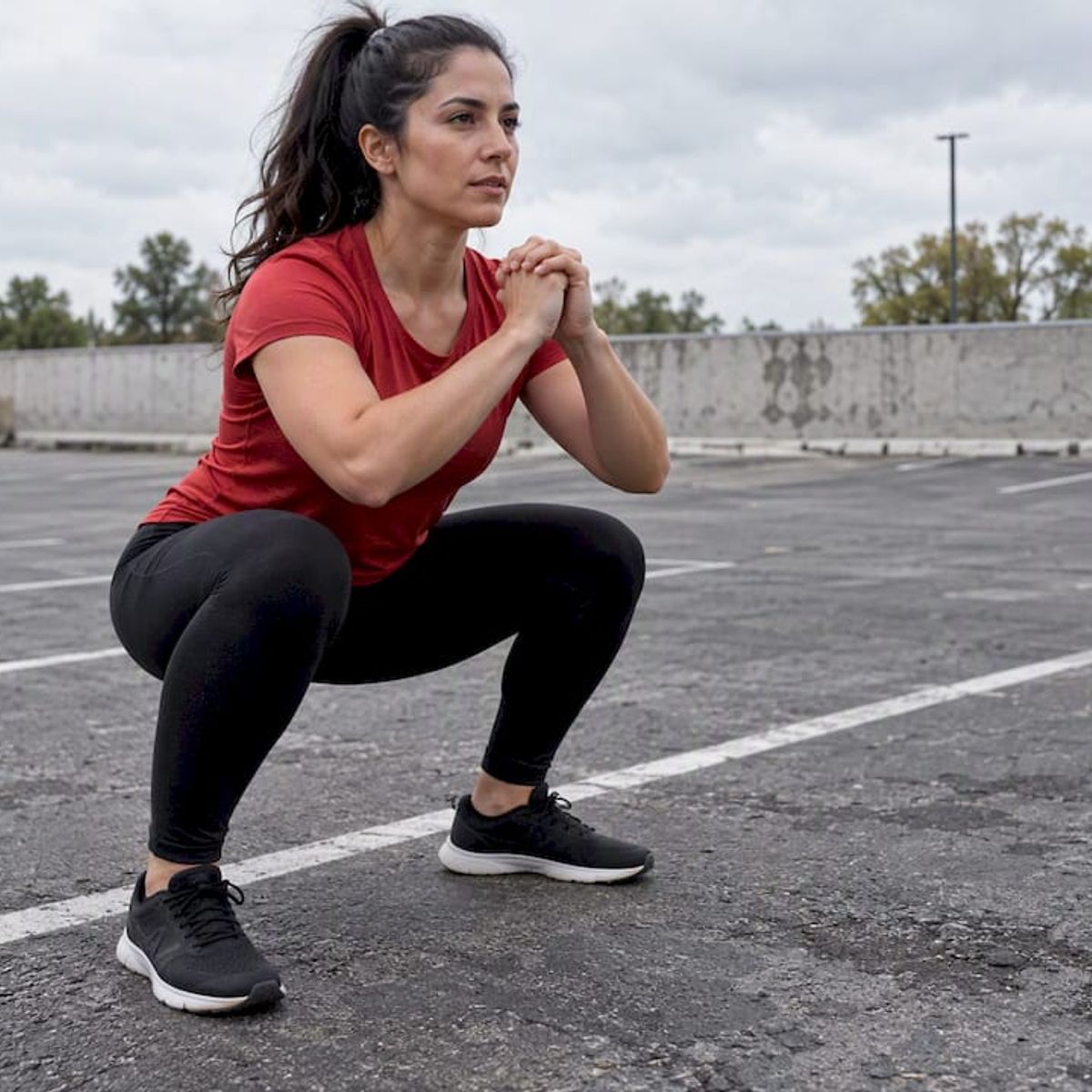
Walk briskly for two minutes along the lot’s edge. Then do 10 slow bodyweight squats, 10 arm circles each direction, 8 walking lunges per leg and 10 hip circles. Your breathing should rise and your joints should feel loose, but you should not be tired.
The circuit
ExerciseBeginner repsWhat it trainsParking lot setup
Bodyweight squat
10
Legs, glutes
Stand beside a curb; sit back as if onto a low seat
Incline push-up
8
Chest, shoulders, arms
Hands on a sturdy bumper, wall or bench; step back until your body is a straight line
Reverse lunge
6 per leg
Legs, balance
Step back off the curb or a painted line
Forearm plank
20 seconds
Core
Elbows under shoulders on a clean patch of pavement
Side shuffle
4 spaces each way
Cardio, footwork
Use two painted lines as markers
Move through the five in order with about 15 seconds between them. After the last move, rest one minute, then start again. Do 3 rounds in your first week.
One safety note on the incline push-up: lean on something fixed. Never use a car that could roll, rock or have an alarm. A low concrete wall, a parking block bolted to the ground or a park bench is better. If you are unsure it will hold, use the ground and do push-ups from your knees.
Other moves that work in the same space include running, side shuffles, lunges, slow-motion push-ups and sit-ups, as listed in this outdoor no-equipment circuit guide. Swap them in when you want variety.
Cool-down (3 minutes)
Walk slowly until your breathing settles, then hold a gentle quad stretch and a calf stretch for 20 seconds each side. Drink water.
Three ways to use the same lot
Different days can have different jobs. Here are three formats that keep the week from feeling repetitive.
- The 10-minute timer round. Run the circuit above as many times as you can in 10 minutes. Write down the number of rounds. Beat it next week. This is the quickest format and the one we suggest for crowded weeks.
- The line drill. Use the painted spaces for intervals: 20 seconds of side shuffles or brisk jogging, 40 seconds of easy walking, repeated for 8 to 10 rounds. This is the aerobic session.
- The strength ladder. Do 5 squats and 5 incline push-ups, rest, then 6 and 6, then 7 and 7, up to 10 and 10. Rest as long as you need between rungs. This one is calm and focused, and it suits days when you feel low on energy.
A simple weekly pattern: timer round on Monday, line drill on Wednesday, strength ladder on Friday, and a longer brisk walk on the weekend. That gives you two muscle-strengthening days and a base of aerobic work.
Making it easier or harder
Progress should be dull and steady. The U.S. Department of Health and Human Services suggests that you add activity gradually, by being active longer or more often. ACSM likewise advises people who do not exercise regularly to start at light-to-moderate intensity and build up from there. Change one variable at a time.
To make it easier
- Raise your hands higher for push-ups, or do them from your knees.
- Squat to a curb or bench so you have a fixed depth.
- Hold lunges with a hand on a wall for balance.
- Plank from your knees or for 10 seconds.
- Take longer rests, or do 2 rounds instead of 3.
To make it harder
ACE notes that body-weight moves become more challenging with pulses or isometric holds, and it illustrates progressions from knee push-ups to toe push-ups and then plyometric versions. In practice:
- Add a 3-second pause at the bottom of every squat.
- Pulse 5 times at the bottom of each lunge.
- Lower the incline: move your hands from a bumper to a curb, then to the ground.
- Extend the plank to 45 seconds, then 60.
- Add a round, or add a fourth day.
A useful test: you should finish a round able to say a short sentence out loud. If you cannot talk at all, back off. If you could recite a paragraph, push a little harder.
Heat, cold and weather
Connecticut gives you every kind of weather, and a parking lot gives you no shade and no shelter. Asphalt soaks up sun in summer and shows ice in winter.
Hot days
The CDC advises outdoor exercisers to choose cooler times of day, wear loose, lightweight clothing and drink more water than usual, without waiting until they are thirsty. In a lot, that means early morning or after sunset, and a spot in the shade of a building if one exists. The CDC also says that if you feel faint or weak, you should stop all activity and get to a cool place. Do not push through it.
Organized sports use temperature-and-humidity measures to decide when to cut practices short; if you want to see how a formal approach works, a heat policy based on WBGT readings lays out the idea. For your own sessions, keep it simpler: if the day feels punishing before you start, move indoors.
Fluids matter at both ends of a session. These hydration tips for athletes are a reasonable starting point for planning what to drink around training.
Cold days
For cold weather, ACSM recommends three layers: a moisture-wicking inner layer, an insulating middle layer and a waterproof, windproof, breathable outer layer. ACSM describes cold injury as a real risk and frames cold-weather clothing as a way to manage moisture and heat balance. That is the point of layers: you can peel one off as you warm up and put it back on when you stop. Cover your hands, ears and head, and keep the warm-up a little longer than in summer.
Rain and ice change the surface more than the temperature. Skip shuffles and lunges on wet or icy pavement. Plank and push-up variations can move to a dry spot or indoors.
Where parking lot workouts fall short
Being honest about the limits will save you time.
- Load. Body weight stops being enough for legs fairly soon. Once 20 squats feel easy, you need added resistance to keep building strength.
- Feedback. Nobody watches your form. Sloppy squats and sagging planks become habits.
- Pulling. Rows and pull-ups are hard to do in a lot, so your back gets less work than your chest. A gym can fix this fast. Our guide on how to build strength with limited equipment shows how to balance a program when you have little gear.
- Consistency. Rain, darkness and winter will break a plan that depends on weather.
None of that is a reason to skip the lot. It is a reason to treat it as one tool, not the entire plan.
Our perspective: what we see with new trainees
We coach adults and students at our Stratford and Bridgeport locations, and many of them arrive saying the same thing: they trained alone, got bored or sore or unsure, and stopped. The workouts were rarely the problem. The problem was that nobody told them what to do next.
So here is how we would use a parking lot workout. Treat it as a bridge. It gets you moving three days a week without a membership or a commute, and it teaches your body the basic patterns: squat, hinge, push, brace, step. Do that for a few weeks and you will learn what you like and what you avoid.
Then add structure. Small, capped classes and certified coaches matter most at the moment when body weight stops feeling like enough and you start wondering about form, loading and what to eat. A coach can look at your squat and tell you in ten seconds what a video cannot. That is also why our boxing coaching is real technique, not cardio-boxing choreography: it is easier to learn good habits early than to unlearn bad ones.
If you are anxious about walking into a gym, you are not alone, and it is one of the main reasons we put beginners first and run no contracts. Start in the lot if that is where you feel comfortable. Come in when you are ready.
— Malcolm
When a coach makes sense
Move from the lot to a coached setting when any of these is true:
- You have stalled for three or more weeks.
- You feel the same joint ache after every session.
- You have a health condition and want a plan that respects it. ACSM notes that working with an exercise professional can help tailor exercises to your abilities and minimize injury risk.
- You want to lose fat and need food and training aligned.
- You want to learn boxing properly.
If you are unsure how to get the most from a trainer once you have one, we wrote about working with a fitness coach effectively. For a broader view of what each format costs and delivers, see private fitness explained.
Take the next step with Level Up Gym
Every new member at Level Up Gym starts with a free class or consult and a written, individualized plan. There are no contracts. Our coaches work with beginners at Stratford and Bridgeport, and our options include:
- 6-Week Onramp: a structured start for beginners, $699 one-off. Our six-week beginner plan explains the movement-first approach.
- Large group classes: $24.99 to $59.99 per week.
- Small group personal training (2 to 4 people): $74.99 to $174.99 per week per person.
- 1-on-1 personal training: $149.99 to $359.99 per week.
You can see all current membership options on our membership page. If boxing is what pulls you in, try our free boxing class in Stratford. Prefer to train at home or in the lot with remote guidance? Look at online personal training.
FAQ
Is a parking lot workout enough exercise?
For a beginner, yes, if you do it regularly. Federal guidelines call for at least 150 minutes of moderate aerobic activity a week and muscle-strengthening on at least 2 days. A circuit three days a week plus brisk walking can cover that. Add resistance over time as the moves get easy.
Is 20 minutes of cardio a day enough?
Twenty minutes on five days adds up to 100 minutes, which is a good base. Add a longer brisk session or a few more walks to reach 150 minutes a week. Even 5-minute bouts count, so short days are not wasted.
What is the best beginner parking lot workout?
Start with squats, incline push-ups, reverse lunges and planks, plus a short side shuffle. Run 3 rounds with a minute of rest between them. Use a fixed surface for push-ups, and keep the first week easy.
Is it safe to work out in a parking lot?
It can be, if you choose a quiet corner away from moving cars, check the surface and watch the weather and air quality. Stop and get to a cool place if you feel faint in the heat. If you have a heart, metabolic or kidney condition, or symptoms, ask your doctor before starting.
Sources
- Get Active, MyHealthfinder (U.S. Department of Health and Human Services)
- Move Your Way: Community Playbook Campaign Talking Points
- Body-weight Training (American Council on Exercise)
- Staying Active with Asthma: Why Air Quality Matters (ACSM)
- Exercising in Hot and Cold Environments (ACSM)
- Exercising in the Cold: Chilled, not Shaking! (ACSM)
- Heat and Athletes (CDC)
- 6 Outdoor No-Equipment Circuit Training Workouts
- Heat policy based on WBGT
- Hydration tips for athletes