Build Real Strength in 6 Weeks: Beginner Fitness Plan, Movement First
This six-week beginner fitness plan builds real strength, better conditioning, and cleaner movement patterns through three progressive phases: technique (weeks 1 to 2), building volume (weeks 3 to 4), and adding intensity (weeks 5 to 6). Expect three to four sessions a week, 30 to 45 minutes each, using nothing more exotic than dumbbells, bodyweight, and a bench. Pair that with simple protein and hydration habits and you have a complete, followable system.
TL;DR:
- Building movement competence in the first two weeks prevents injury and burnout, prioritizing technique over weight or fatigue.
- Progressively increasing volume and intensity over weeks three to six involves adding reps, small weights, and stricter rest without pushing to failure.
- Simple nutrition focusing on protein intake, hydration, and a balanced plate supports strength gains and recovery during the program.
- Consistent sleep and proper form are critical for progress and avoiding setbacks, with soreness typical and manageable in early weeks.
- Coaching or guided programs can notably improve adherence and technique, especially for beginners unfamiliar with proper movement patterns.
Level Up Gym
Build Strength With Expert Coaching
Level Up Gym helps Fairfield County beginners build strength through coached training, with boxing and hybrid workouts available.
Table of Contents
- Your Week-by-Week Six-Week Training Program
- Beginner Workout Templates and Exercise Form Guide
- Simple Nutrition Rules for Beginners
- Recovery, Soreness, and What to Expect Week by Week
- What Coached Beginners Actually Experience
- Why Most Beginner Plans Get the First Six Weeks Wrong
- Ready to Start? How Level Up Gym Makes This Easier
- Sources
- FAQ
Your Week-by-Week Six-Week Training Program
A six-week fitness plan only works if you can actually follow it without a spreadsheet degree. The structure below breaks into three two-week blocks, each with a specific job to do. You are not just doing random workouts for six weeks. You are teaching your body a skill, then loading that skill, then testing it under a bit more stress.
Weeks 1 and 2: Learn the Movements
The entire goal here is competence, not fatigue. Muscle & Strength’s beginner program structure follows this same teach-first logic, and it holds up because most early injuries and burnout come from beginners loading a squat or a deadlift pattern they have not actually learned yet.
- Day 1, full-body strength. Squat pattern, push pattern, pull pattern, and a core hold. Light weight, slow tempo, 2 to 3 sets of 10 to 12 reps.
- Day 2, mobility and light conditioning. Hip openers, shoulder circles, and 15 to 20 minutes of easy cardio like brisk walking or the bike.
- Day 3, full-body strength (repeat Day 1 pattern). Same movements, same loads. Repetition at this stage is the point.
- Day 4, active recovery or rest. A walk, light stretching, or nothing at all.
Sessions run 30 minutes. Anything longer at this phase usually means you are resting too long between sets, not working too hard.
Weeks 3 and 4: Build Volume
Once the movement patterns feel automatic, and you can go through Day 1’s routine without checking a diagram between sets, you are ready to add work. This phase adds a fourth training day and pushes rep ranges and light load increases.
- Day 1, lower-body strength. Squats, lunges, hip hinges. 3 sets of 10 to 15 reps.
- Day 2, conditioning circuit. Bodyweight or dumbbell circuit, 20 to 25 minutes, moderate pace.
- Day 3, upper-body strength. Push-ups or presses, rows, overhead work. 3 sets of 10 to 15 reps.
- Day 4, mobility plus core. 20 minutes of core work and stretching.
- Day 5 (optional), light cardio or rest.
Sessions extend to 35 to 40 minutes. The progressive overload approach coaches recommend for beginners is straightforward: add reps first, and only add small weight jumps of 2.5 to 5 pounds once you consistently hit the top of your rep range with clean form.
Weeks 5 and 6: Add Intensity
This is where the plan asks more of you, but the increase is still modest. You are not maxing out, you are tightening rest periods and adding a genuine intensity component, whether that is a heavier load, a faster circuit pace, or an extra set.
- Day 1, lower-body strength (heavier). Same movements, add weight or an extra set.
- Day 2, conditioning with intervals. Short work-to-rest intervals, 25 minutes total.
- Day 3, upper-body strength (heavier). Same pattern as weeks 3 to 4, tighter rest, added load.
- Day 4, full-body finisher plus mobility. Lighter full-body circuit and stretching.
- Day 5 (optional), cardio or boxing-style conditioning.
Sessions can run up to 45 minutes here. If you train at home, dumbbells, resistance bands, and a sturdy chair or bench cover almost everything in this program. A gym setting adds barbells and machines, but neither is required to follow this six week training program properly. Everything after week 6 is about repeating this cycle at a slightly higher baseline, not starting over.
Beginner Workout Templates and Exercise Form Guide
You need workouts you can actually execute the first time you read them, without guessing what “hinge” means. Here are three complete sessions that map directly onto the schedule above, plus the cues that keep you safe while you learn them.
Template 1: Beginner Full-Body (Weeks 1 to 2)
- Bodyweight squat, 3 sets of 12, rest 60 seconds
- Push-up (or knee push-up), 3 sets of 8 to 10, rest 60 seconds
- Dumbbell row (or resistance band row), 3 sets of 12, rest 60 seconds
- Glute bridge, 3 sets of 15, rest 45 seconds
- Plank, 3 sets of 20 to 30 seconds, rest 45 seconds
Template 2: Upper/Lower Split (Weeks 3 to 4)
- Lower day: goblet squat, Romanian deadlift, walking lunge, dead bug. 3 sets of 10 to 15 each.
- Upper day: dumbbell shoulder press, lat pulldown or band pull-apart, incline push-up, bicycle crunch. 3 sets of 10 to 15 each.
Template 3: Conditioning Circuit (Weeks 5 to 6)
- Jumping jacks, 45 seconds
- Bodyweight squat, 45 seconds
- Mountain climbers, 30 seconds
- Push-ups, 30 seconds
- Rest 60 seconds, repeat 3 to 4 rounds
The five movement patterns underneath almost every beginner program are squat, hinge, push, pull, and core. Get these right and everything else in an easy fitness routine gets simpler.
- Squat: knees track over toes, chest stays tall, weight in the heels. Regress with a box squat (sit to a chair and stand back up) if depth or balance feels shaky.
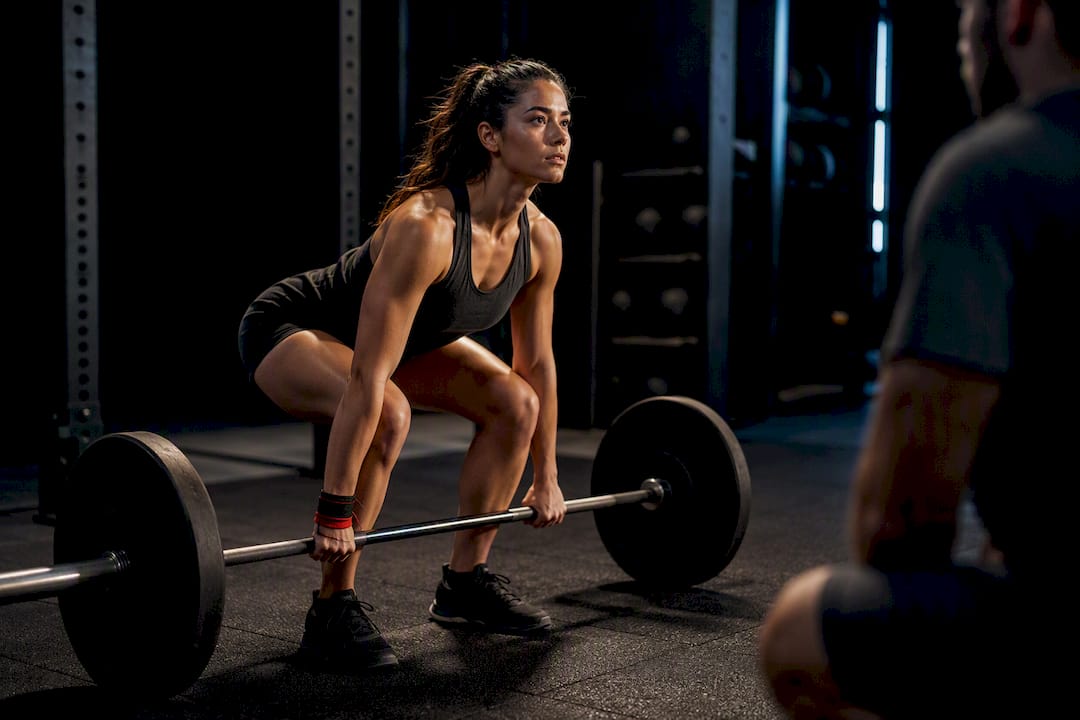
- Hinge: push hips back like closing a car door with them, keep the spine neutral. Practice with a dowel along your back to check for excess rounding before adding a dumbbell.
- Push: elbows travel at roughly a 45 degree angle from the torso, not flared to 90 degrees, which protects the shoulders.
- Pull: squeeze the shoulder blades together before the arms bend, so the back muscles do the work instead of the biceps.
- Core: brace like you are about to take a light punch to the stomach, not by sucking in.
Pro Tip: Slow down the lowering portion of every lift to a 2 to 3 second count. Mayo Clinic’s guidance on movement quality points to controlled tempo as one of the fastest ways beginners build strength safely, and it also makes bad form obvious before it becomes a habit.
Progress a movement by adding reps first, then small load, then trimming rest between sets. If a piece of equipment is not available, a loaded backpack replaces a dumbbell, and a sturdy table edge replaces a suspension trainer for rows.
Simple Nutrition Rules for Beginners
You do not need a meal plan with grams tracked to the decimal to make progress in six weeks. You need a handful of rules applied consistently.
Protein: aim for protein at every meal. Harvard Health recommends roughly 20 grams of protein within about 45 minutes after training, spread across meals rather than loaded into one sitting. That looks like a couple of eggs and Greek yogurt at breakfast, chicken or beans at lunch, and fish, tofu, or lean beef at dinner.
Pre and post-workout timing: Mayo Clinic notes that a snack eaten within an hour of a workout mostly prevents hunger rather than adding usable energy, especially for sessions under 60 minutes, which covers nearly every workout in this plan. A full breakfast before a morning session matters more than a pre-workout snack does. After training, a normal meal with protein and carbohydrates within a couple of hours works fine for most people; check meal timing guidance for a closer look at pre and post-workout windows.
Hydration: water covers you for every workout in this six week fitness program. Sports drinks and electrolyte mixes only start to matter once sessions run past 75 to 90 minutes or involve heavy sweating in hot conditions, territory this beginner plan does not reach. If you are curious about when electrolyte drinks beat plain water, that threshold is worth knowing even if you are not there yet.
Meal pattern: picture your plate divided in half for vegetables, one quarter for lean protein, and one quarter for whole grains or starchy vegetables. That single visual replaces most of what a calorie-counting app tries to do for a beginner.
Quick fact: Beginners often notice measurable strength gains within the first 2 to 6 weeks of consistent training, though visible physique changes typically take longer than a single six-week cycle.
- Eat a real breakfast before morning training sessions, not just coffee.
- Get protein after each workout.
- Drink water throughout the day, not just during workouts.
- Keep meals simple and repeatable rather than complicated and impressive.
If you have a medical condition, are pregnant, or have a complicated relationship with food, loop in a registered dietitian before making changes. A dietitian can tailor these general rules to your situation in ways a generic guide cannot.
Recovery, Soreness, and What to Expect Week by Week
Soreness in week 1 is normal and it is not a sign anything went wrong. It usually peaks around 24 to 48 hours after a new movement and fades within a few days on its own. What matters more is what you do with weeks 2 through 6.
Energy and coordination tend to improve fast. Many beginners notice they move better and feel less winded within the first one to two weeks, even before strength numbers change much. Measurable strength gains, like adding a rep or a few pounds, typically show up by weeks 4 to 6 for people training consistently three to four times a week.
- Prioritize form over load every single session, even in week 6.
- Increase reps before you increase weight, and only add load once the top rep range feels controlled.
- Sleep 7 to 9 hours when possible. It affects recovery more than almost any other single factor.
- Treat week 6 as a natural point to deload slightly (lighter loads, same movements) before starting a fresh cycle.
- See a doctor or physical therapist if soreness turns into sharp pain, swelling, or pain that lasts more than a week.
For a deeper breakdown of managing day-to-day soreness without derailing your schedule, Level Up Gym’s guide to workout recovery covers active recovery options that fit right into the rest days built into this plan.
What Coached Beginners Actually Experience
Self-guided plans work. Coached ones tend to work faster, mostly because someone else is watching your form and adjusting your load before a small mistake becomes a habit. Level Up Gym built its beginner personal training program around that exact gap, and the numbers back it up: beginners who start with structured coaching show roughly 64% better attendance consistency over their first six weeks compared to those going it alone.
The difference isn’t motivation. It’s having someone catch a squat pattern going sideways in week 2, before it turns into a knee problem in week 5.
Level Up Gym also runs targeted starter formats for specific needs, including a women’s upper body starter plan and a 20 to 25 minute boxing starter built for adults over 50 who want cardio without heavy joint stress.
The trade-off is straightforward. Self-guided training costs nothing extra and works fine if you are disciplined about checking your form. Coached training costs more but shortens the learning curve, particularly for anyone who has never lifted anything heavier than groceries.
Why Most Beginner Plans Get the First Six Weeks Wrong
Most beginner fitness content sells intensity when it should be selling competence. You will find plenty of six week fitness plan templates online that push beginners into heavy lifting or brutal circuits by week 2, and the dropout rate on those programs is predictable. Soreness turns into dread, form breaks down, and people quit before their body has even learned what a proper squat feels like.
The plan that actually works looks almost boring for the first two weeks. That is by design. Movement quality is the unglamorous variable that determines whether weeks 3 through 6 go well or fall apart. Skip it, and you are building volume on a shaky foundation.
The nutrition side gets overcomplicated too. Beginners do not need macro tracking in week 1. They need protein at meals, water throughout the day, and a plate that is mostly vegetables. Save the precision for later, once the habit exists to refine.
If there is one thing to prioritize above everything else in this program, it is consistency over the first two weeks, not intensity. A missed heavy set in week 5 barely matters. A missed habit in week 1 usually means the whole six weeks unravels.
— Malcolm
Ready to Start? How Level Up Gym Makes This Easier
Following a six week beginner fitness plan on your own works, but it asks a lot of you: tracking your own progress, catching your own form mistakes, and staying motivated without anyone checking in. Beginner-friendly programs remove that guesswork with coaches who build the same phased structure into real sessions, at your pace.
The hybrid training programs at Level Up Gym follow this exact teach, build, intensify structure, combined with boxing conditioning that most home routines cannot replicate. If nutrition is your weak spot, the meal planning and coaching program turns the protein and hydration rules above into a plan specific to your goals and schedule. For tracking your own numbers as you go, Level Up Gym’s free fitness calculators can estimate your daily calorie and protein targets in a couple of minutes.
Book an introductory session at a local gym and see what the first two weeks of guided coaching actually feel like compared to going it alone.
Sources
This program draws on established nutrition and fitness timeline guidance rather than guesswork. Mayo Clinic informed the pre-workout snack and timing rules. Harvard Health shaped the protein targets and post-workout refueling advice. Healthline provided the realistic timeline for strength and energy improvements. Muscle & Strength offered the phased periodization structure that shaped the week-by-week schedule. For readers curious how other skill-based training builds progress checkpoints, this surfing skills breakdown from a partner site outside the fitness space follows a similar teach-then-build logic worth comparing.
- Mayo Clinic — Eating and exercise: 5 tips to maximize your workouts
- Harvard Health — Feeding your fitness
- Healthline — How long to get in shape
FAQ
Is It Possible to Get Fit in Six Weeks?
Yes, for baseline strength, energy, and movement skill. Healthline’s research summary notes beginners often see measurable improvements within 2 to 6 weeks, though major physique changes usually take longer.
What Is the 3-3-3 Rule for the Gym?
Definitions vary depending on the source, and there is no single agreed-upon version of this rule in mainstream fitness guidance. Rather than repeat an unverified formula, this plan uses a clearer structure: three phases over six weeks, each with a specific training goal.
Can I Improve My Fitness in Six Weeks?
Yes. Consistent training three to four times a week for six weeks typically improves cardiovascular endurance, movement coordination, and baseline strength, especially when the first two weeks focus on technique before adding volume.
Is Six Weeks Enough to Get Toned?
Six weeks is enough to notice firmer muscles and better definition in some areas, particularly if nutrition supports the training, but a fully “toned” look usually requires more than six weeks of consistent work. Treat this program as the foundation, not the finish line.
Do I Need a Gym to Follow a Six-Week Beginner Plan?
No. This home fitness plan works with dumbbells, resistance bands, or just bodyweight. A gym setting like Level Up Gym adds coaching and equipment variety, but it is not required to complete the six weeks successfully.