Orthodox vs Southpaw: How to Pick Your Boxing Stance
An orthodox stance puts your left foot and left hand forward, and your right hand stays back for power. A southpaw stance is the mirror image: right foot and right hand forward, left hand back. Most right-handed people start orthodox and most left-handed people start southpaw, but handedness is a starting point, not a rule. This guide shows you how to stand in each, how to decide, and what to fix in your first weeks.
Level Up Gym
Find Your Boxing Stance
Level Up Gym offers boxing training for Fairfield County adults, with beginners welcome at its Stratford and Bridgeport locations.
TL;DR
- Orthodox leads with the left side, southpaw leads with the right. They are mirror images, and the guard, footwork and punches are the same ideas flipped.
- Pick your stance by testing both: balance, comfort, and how naturally you jab. Your dominant hand is a guide, not a verdict.
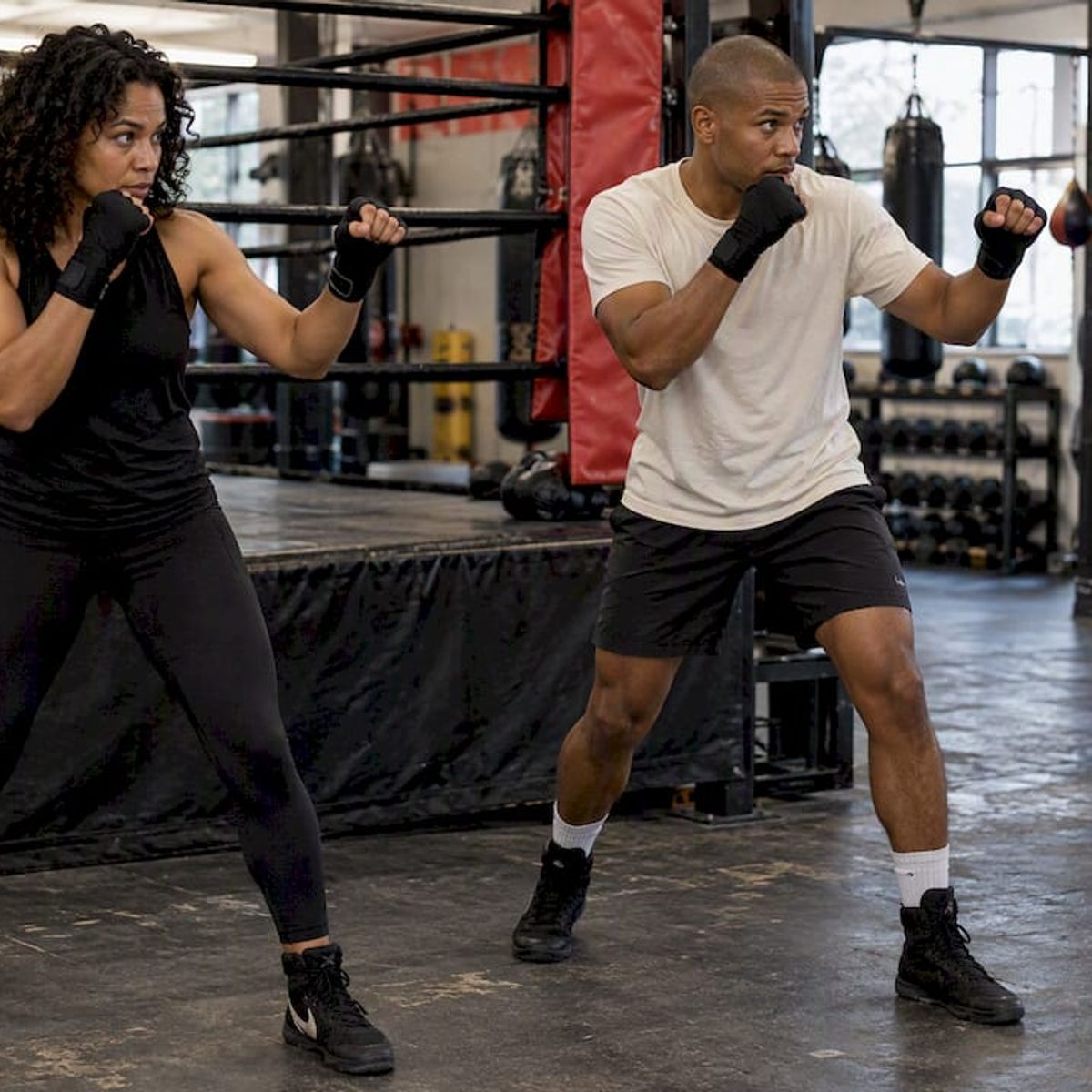
- The basic stance is about shoulder-width feet, body turned slightly sideways, weight even, rear heel up, hands by your face, chin tucked.
- Common faults are standing square, leaning onto the front leg, feet too wide or narrow, and a flat back heel.
- Learn one stance well before you experiment with switching.
Table of Contents
- What orthodox and southpaw actually mean
- How to stand in a basic boxing stance
- Why the rear hand matters: the power logic
- How to choose your stance as a beginner
- Stance mistakes to fix early
- Fighting the other stance
- Can you switch stances?
- Perspective: what we see on the gym floor
- Train your stance with a coach
- A simple practice routine for your first two weeks
- FAQ
- Sources
What orthodox and southpaw actually mean
The difference is which side faces your opponent. An orthodox boxer is typically right-handed and holds the left hand and left leg in front, closer to the opponent. A southpaw is typically left-handed and leads with the right foot and right hand. The two stances are mirror images of one another.
That mirror has a practical meaning. In both stances, the rear hand is the power hand and the lead hand sets things up. Here is how it maps out:
OrthodoxSouthpaw
Lead foot
Left
Right
Lead hand (jab)
Left
Right
Rear hand (cross)
Right
Left
Rear foot pivots to power
Right
Left
Usually chosen by
Right-handed people
Left-handed people
The Irish Athletic Boxing Association’s beginner guide says orthodox starts with the left leg forward and southpaw starts with the right leg forward, and that both use the same basic guard.
So when someone asks about the orthodox and southpaw difference, the honest answer is smaller than the internet makes it sound. The mechanics are identical. What changes is which side is near your opponent, and that changes angles, which we cover below.
How to stand in a basic boxing stance
Whether you are orthodox or southpaw, build the stance from the ground up. Use the orthodox version below, then flip left and right if you are a southpaw.
- Set your feet. Stand with feet about shoulder-width apart. The IABA guide says slightly wider than shoulder width, then step forward with your lead leg and adjust until you feel balanced. The IBA Coach Manual also describes shoulder-width feet.
- Turn your body. Aim for a roughly 45-degree sideways angle rather than facing your target square. The same IBA manual recommends this angle, and BBC Sport’s boxing basics guide says to turn slightly sideways.
- Offset the back foot. Keep your rear foot offset, not directly behind the lead foot. Boxing Scotland’s toolkit recommends this, with weight over the balls of your feet.
- Bend the knees, lift the back heel. Knees slightly bent, weight equal on both legs, rear heel raised. That is the IBA manual’s description, and BBC Sport agrees on a slightly raised rear heel and flexed front knee.
- Build the guard. Raise both hands beside your face, tuck your chin and keep your elbows close. The IBA manual puts the lead hand at eye level and the rear fist near the chin.
- Look forward. Eyes up, over your lead shoulder, not down at your feet.
Check yourself in a mirror, then move: take a step forward, back, left and right, without crossing your feet and while keeping the distance between your legs consistent. A good stance is a platform for movement and defense, not a pose you hold. If you lose balance when you step, the stance is the problem, not your fitness.
We go deeper on moving in our guide to boxing footwork drills, and you can rehearse the stance alone with a shadow boxing workout.
Why the rear hand matters: the power logic
The standard principle for choosing a stance is to put your dominant, stronger hand and leg to the rear. The reason is body mechanics: the rear arm uses rotation of the hips and torso for power, while the lead leg helps drive you forward into attacks.
That is why right-handers go orthodox. Their right hand throws the cross from the back, where it has the longest path and the most rotation behind it. Left-handers do the opposite and become southpaws.
There is a counterargument you will hear in gyms: a strong hand in front can make the lead hand a power tool, which some coaches like. In practice, a strong hand held in front can leave the weaker hand too far back to land well. Most coaches still start people with the strong hand behind. That is a sensible default, and you can test it for yourself.
How to choose your stance as a beginner
Start with handedness, then verify. A beginner can use hand dominance as a guide, test both stances for comfort and balance, and check how well they move and jab before committing.
Precision Striking’s 2024 guide adds an honest caveat: handedness is a useful starting point but not an absolute rule. A left-handed person may prefer orthodox if leading with the right foot feels more balanced, and sparring can help settle it.
Here is a ten-minute test you can run at home:
- Balance test. Stand in each stance and shift your weight forward and back. Which one feels steadier without effort?
- Movement test. Take five steps in each direction in each stance. Notice which stance makes you cross your feet or wobble.
- Jab test. Throw 20 slow jabs from each stance. Which side feels more natural and relaxed, and which one keeps your chin down?
- Cross test. Throw 20 slow crosses. Does the rear hand rotate through smoothly?
- Repeat tomorrow. First impressions are noisy. A second test on a different day tells you more.
If both feel equal, go with the handedness default. If one clearly feels better, trust it. Then stay there for weeks, not days. Our first month of boxing article shows how a stance settles in as your footwork and jab develop.
Some people also use their dominant eye as a tiebreaker, positioning it to look down the rear arm. That idea comes from an informal source, so treat it as a curiosity, not a rule.
If you are also weighing up which striking art to take up at all, a comparison such as Muay Thai or kickboxing for beginners shows how to test options over a couple of months before committing, which is the same mindset that works for choosing a stance.
Stance mistakes to fix early
The same faults show up in both stances. Official coaching materials list them clearly:
- Feet too wide or too narrow. Both hurt movement and balance. The IBA manual lists this first.
- Both heels flat. Flat feet make you slow. Keep the rear heel up and stay on the balls of your feet. Boxing Scotland’s toolkit flags a flat back heel and flat-footed movement as errors.
- Standing too upright. You lose power and give a bigger target.
- Lifting the chin. Raising the chin above the hands exposes you.
- Square shoulders. Facing your target head-on is the classic beginner stance, and the same coaching source warns against turning the shoulders square-on.
- Leaning onto the front leg. Transferring weight forward leaves you front-heavy and vulnerable to attack.
Posture also matters for your body, not just your boxing. If you are putting in volume on the bag, a guide on sports injury prevention is worth reading alongside our own boxing injury prevention templates. If something hurts in your knees, hips or lower back after sessions, see a physical therapist or your doctor rather than training through it.
Fighting the other stance
When an orthodox fighter meets a southpaw, the mirror image changes the geometry. Lead feet end up on the same side of the center line, so they compete for the outside position. One coaching write-up says lead-foot positioning is crucial in these matchups: an orthodox fighter often aims to step the right foot outside the southpaw’s lead foot to create better attack angles.
For a beginner, here is what that means in the gym:
- You will mostly train against orthodox partners. If you are a southpaw, that is normal and you will get used to it quickly.
- If you are orthodox, deliberately ask to work with a southpaw partner now and then. It feels awkward the first time.
- On the pads, your coach will hold mitts for your stance. Good mitt drills change with the stance, which is why we like coach-led mitt work.
The quick rules that most coaches teach: watch the lead foot first, try to land your lead foot outside theirs, and avoid getting stuck with your feet tangled in the middle. Do not try to memorize anything fancy before your basic stance is automatic.
Can you switch stances?
Yes, some boxers switch mid-round, but that is a skill for later. The sensible advice is to perfect your offense and defense from one stance before attempting to switch. Spreading your first months across two stances means you are mediocre in both.
A useful middle path: once your main stance is comfortable, spend a few minutes of shadow boxing in the other one, just to understand your partners. Keep your real training in your main stance.
Perspective: what we see on the gym floor
We coach beginners every week, and almost nobody arrives knowing their stance. We start with a quick test like the one above, not a lecture. Most right-handers land in orthodox, most left-handers in southpaw, and a surprising number of people tell us the “wrong” one feels better. When that happens, we let them keep it.
The bigger problem is rarely orthodox vs southpaw. It is balance. A beginner who is square, flat-footed and leaning forward will struggle in either stance. So we fix the feet first, then the guard, then the punches. That is also why our classes are capped in size: a coach needs to see your feet to correct them.
Our boxing classes are real boxing coaching, not cardio boxing, and our coaches include pro boxers. Every new member gets a written, individualized plan, so your stance, goals and schedule are written down, not guessed. If you are choosing where to train, our guide to choosing a boxing gym lists what to look for.
— Malcolm
Train your stance with a coach
A stance is easier to fix with a coach watching than with a mirror. At Level Up Gym in Stratford and Bridgeport, CT, beginners are welcome, there are no contracts, and every new member starts with a free class or consult. You can book a free boxing class to find your stance with a coach beside you.
If you want more structure, our 6-Week Onramp is a $699 one-off program built for newcomers. Our boxing classes are the place to practice once you know your stance. Large group classes are listed at $24.99 to $59.99 per week, small group training (2 to 4 people) at $74.99 to $174.99 per week per person, and 1-on-1 personal training at $149.99 to $359.99 per week. See the membership page for the current options.
A simple practice routine for your first two weeks
You do not need a gym to start. Fifteen minutes, four days a week is plenty. If you prefer to start at home, our boxing training at home plan covers the setup.
- Stance check (2 minutes). Set your feet, turn your body, lift your rear heel, raise your guard. Look in a mirror from the front and from the side.
- Step drill (3 minutes). Step forward, back, left and right without crossing your feet. Keep your feet about the same distance apart after every step.
- Jab only (4 minutes). Slow jabs, returning your hand to your face every time. Check your chin stays down.
- Jab and cross (4 minutes). Add the rear hand. Let your rear heel and hips rotate. Do not lean onto the front leg.
- Reset (2 minutes). Stop, walk around, and rebuild the stance from the ground up.
After two weeks, retest your stance choice. If it still feels right, you are done deciding. If the other side felt better, switch once, then commit again for a few weeks.
Gloves matter when you start hitting bags. Here is our guide to training vs sparring gloves. If you want to build strength alongside your boxing, see boxing and strength training.
FAQ
Is it better to be orthodox or southpaw?
Neither is better in general. The right stance is the one where you are balanced, can move, and can jab and cross comfortably. Handedness is a good starting guide, and testing both stances settles the rest.
What makes a boxer a southpaw?
A southpaw is typically a left-handed boxer who stands with the right foot and right hand forward. The left hand stays back as the power hand. Some left-handers prefer orthodox if it feels more balanced, so the label follows your stance, not your handedness.
Do I stand differently in a southpaw stance?
No, the structure is the same, flipped. The same feet width, sideways angle, raised rear heel and guard apply. You step forward with the right leg instead of the left.
Should beginners learn both stances?
Not at first. Get one stance balanced and automatic before you work on switching. Your coach can introduce the other stance later, once your footwork is steady.
Sources
- 7 Steps to a Solid Boxing Stance
- A Beginners Guide, Irish Athletic Boxing Association
- IBA Coach Manual 2019
- Skill Fundamentals: Stance and Guard, Boxing Scotland
- BBC Sport: Boxing basics
- Boxing Stance Basics for Better Balance and Power
- Southpaw vs Orthodox: Boxing Stances and How to Choose
- Southpaw vs Orthodox: How to Decide Which Stance to Fight
- Southpaw vs Orthodox guide, MyBoxingCoach (PDF)
- How to Counter a Southpaw as an Orthodox Fighter
- Muay Thai or Kickboxing for Beginners
- What is sports injury prevention? A 2026 guide