
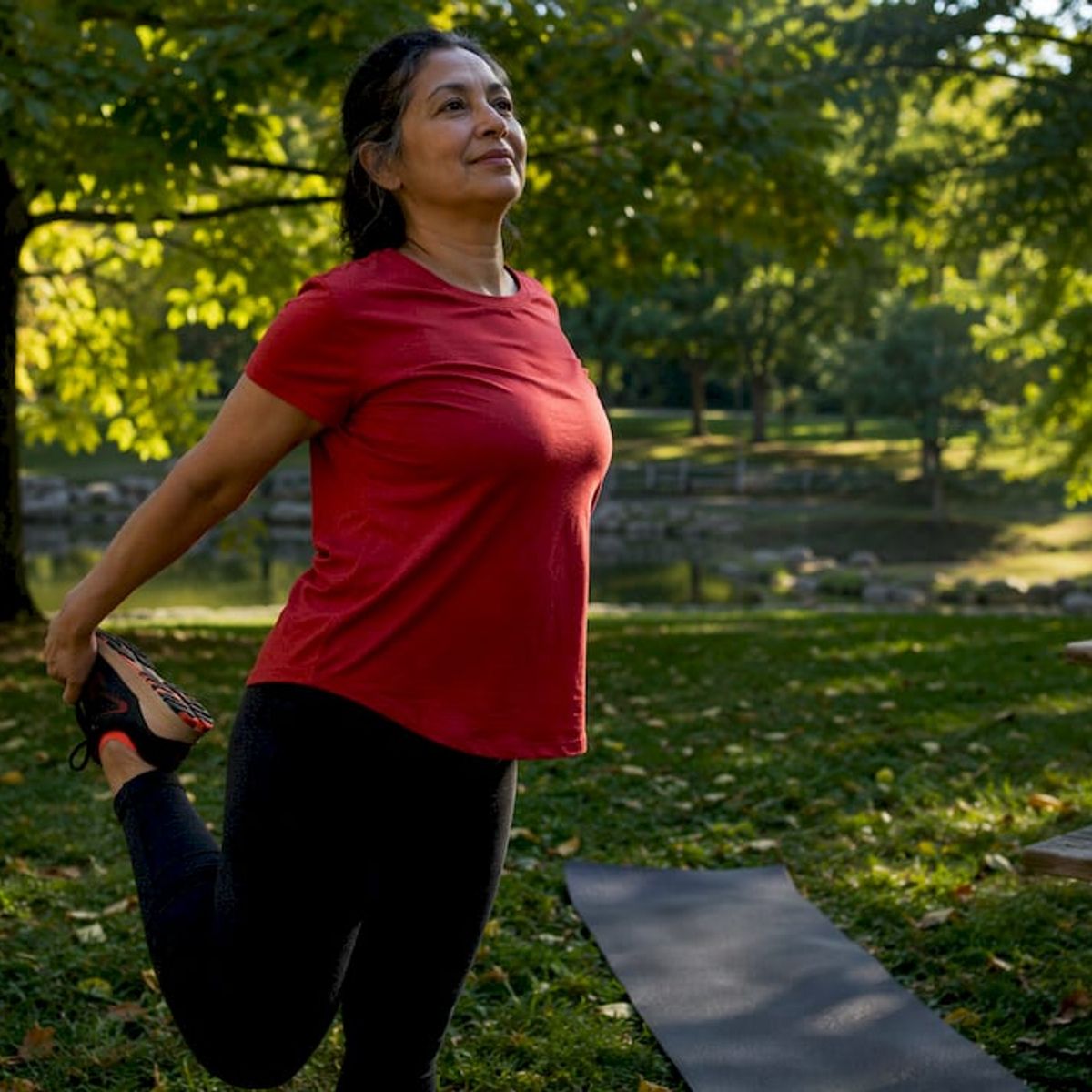
Energy-Boosting Workout Examples for Tired Adults
Short, regular movement reliably raises energy. That is the core answer, and it holds whether you have five minutes at your desk or twenty minutes before work. The best energy-boosting workout examples are not the hardest ones. They are the ones you will actually do, done consistently. Three routines you can try today:
- 5-minute desk pick-me-up: Stand up, do 10 bodyweight squats, 10 arm circles each direction, and 20 marching steps in place. Repeat the sequence twice. No equipment, no sweat, immediate lift.
- 10-minute low-intensity walk: Step outside or pace a hallway at a comfortable pace. Breathe in for 4 counts, out for 4. No pushing the pace. This alone can reduce tiredness within minutes, according to NHS guidance.
- 15-minute hybrid circuit: Alternate 40 seconds of movement (jumping jacks, push-ups, bodyweight lunges) with 20 seconds of rest. Four rounds. Perceived exertion should stay around a 5 out of 10.
If you feel chest pain, sudden dizziness, or unusual shortness of breath during any routine, stop immediately. New or unexplained fatigue that does not improve with rest warrants a conversation with your doctor before starting a new program.
Table of Contents
- How exercise actually raises your energy
- Which exercise types give you the biggest energy return?
- Six ready-to-use workouts that actually raise your energy
- How to pick the right routine when you are too tired to start
- How often to work out and when you will notice a difference
- What the research actually says about exercise and energy
- Safety guidance and when to stop
- Key Takeaways
- The part most fitness advice gets wrong about energy
- Level Up Gym can put structure behind your energy goals
- Useful sources
- FAQ
How exercise actually raises your energy
Exercise raises energy through three overlapping systems: cellular, circulatory, and hormonal. Understanding which one is doing the work helps you pick the right routine for your situation.
At the cellular level, exercise stimulates mitochondrial biogenesis, meaning your muscle cells produce more mitochondria and improve their function. More mitochondria means more ATP, the molecule your body runs on. This is a long-game benefit that builds over weeks of consistent training.
Circulation improves faster. Even a single session increases blood flow and oxygen delivery to the brain and muscles, which is why a short walk can clear mental fog within minutes. Hormonal changes follow: endorphins rise, cortisol patterns normalize with regular training, and sleep quality improves. Better sleep is one of the most underrated energy benefits of regular movement, since deeper sleep stages drive the recovery that powers the next day.
One finding worth knowing: perceived energy can improve well before your fitness does. You do not need to get measurably fitter to feel more energized. The central nervous system responds to movement quickly, which is why even a five-minute routine can shift how you feel.
Which exercise types give you the biggest energy return?
Not every workout works the same way for energy. The right type depends on how depleted you are right now and what you are trying to fix.
Aerobic exercise (brisk walking, cycling, jogging) is the most studied for energy. It drives circulation, endorphin release, and sleep improvements simultaneously. Low-intensity aerobic movement (leisurely walking, easy cycling) is especially effective when fatigue is persistent. A University of Georgia study found that low-intensity exercise reduced fatigue symptoms by 65% in sedentary volunteers, compared to 49% for moderate-intensity, with both groups reporting roughly a 20% energy increase versus controls.
Strength training preserves muscle mass and mitochondrial density, protecting your long-term energy baseline. It does not give an immediate buzz the way cardio does, but two to three sessions per week prevent the slow energy drain that comes from muscle loss.
Mobility and stretching reduce physical tension and calm the nervous system. They are not high-output, but they break the fatigue-stiffness cycle that desk workers know well. Mind-body work (yoga, tai chi) adds breath control and parasympathetic activation, which lowers the stress load that drains energy in the first place.
Exercise typeBest forTime neededEquipment
Low-intensity aerobic
Immediate lift, persistent fatigue
10–20 min
None
Moderate aerobic
Sustained energy, mood
20–30 min
None/minimal
Strength training
Long-term energy, muscle preservation
20–40 min
Optional weights
Mobility/stretching
Tension relief, nervous system reset
5–15 min
None
Yoga/tai chi
Stress-driven fatigue, focus
15–30 min
None
Pro Tip: When fatigue is persistent and you keep skipping moderate workouts, that is your body telling you something. Drop the intensity. A 15-minute easy walk done consistently will outperform a 30-minute hard session you dread and avoid. Matching intensity to your current capacity is not a compromise. It is the smarter strategy, and the UGA research backs it up.
Six ready-to-use workouts that actually raise your energy
These six routines cover the full range from desk-bound to gym-ready. Each one includes a time, an effort cue, and two modifications so you can adjust on the fly.
1. 5-minute desk pick-me-up
Time: 5 minutes | RPE: 3/10 (easy, no sweat)
Stand up from your chair. Do 10 bodyweight squats (sit back like you are lowering into the chair, then stand). Follow with 10 shoulder rolls each direction, 10 neck half-circles, and 20 marching steps in place. Repeat the sequence twice.
- Easier: Stay seated. Do seated leg raises, shoulder shrugs, and wrist circles.
- Harder: Add 10 calf raises and 10 standing hip hinges between rounds.
Frequency: Every 60–90 minutes during a workday. This is habit-stacking at its simplest.
2. 10-minute low-intensity walk with breathing drills
Time: 10 minutes | RPE: 2–3/10 (conversational pace)
Walk at a pace where you could easily hold a conversation. At the 2-minute mark, begin box breathing: inhale 4 counts, hold 4, exhale 4, hold 4. Repeat the breathing pattern for 3 minutes, then return to natural breathing. Finish the last 5 minutes at your comfortable pace.
- Easier: Walk indoors, pace a hallway or living room.
- Harder: Add a slight incline or extend to 15 minutes.
Frequency: Daily, especially mid-afternoon when energy typically dips.
3. 12-minute low-impact hybrid circuit
Time: 12 minutes | RPE: 4–5/10 (light effort, slight warmth)
Four rounds of: 40 seconds step-touches side to side, 40 seconds slow push-ups (knees down is fine), 40 seconds standing hip circles, 20 seconds rest. No jumping. Keep the pace controlled.
- Easier: Reduce to 30 seconds of work, 30 seconds rest.
- Harder: Replace step-touches with low-impact jumping jacks and add 10 glute bridges at the end of each round.
Frequency: 3 times per week as a standalone energy session.
4. 20-minute moderate interval walk/run
Time: 20 minutes | RPE: 5–6/10 (you can talk, but not comfortably)
Warm up with 3 minutes of easy walking. Then alternate: 90 seconds brisk walk or light jog, 60 seconds easy walk. Repeat 6 times. Cool down with 2 minutes of slow walking.
- Easier: Keep the entire session at a brisk walk. Skip the jog.
- Harder: Extend the run intervals to 2 minutes, or add a hill.
Frequency: 2–3 times per week. This is the short workout format that produces measurable energy and mood benefits without requiring a full gym session.
5. 15-minute bodyweight strength mini-circuit
Time: 15 minutes | RPE: 5–7/10 (moderate, some muscle burn)
Three rounds of: 12 bodyweight squats, 8 push-ups, 10 reverse lunges (5 each leg), 15-second plank hold, 30 seconds rest. Move at a controlled pace, not rushed.
- Easier: Cut to 2 rounds, use wall push-ups, and skip the plank.
- Harder: Add a jump to the squats, elevate feet for push-ups, and hold the plank for 30 seconds.
Frequency: 2 times per week. Pair with an aerobic day for a balanced strength and cardio approach that sustains energy across the week.
6. Restorative mobility and breath routine
Time: 10–15 minutes | RPE: 1–2/10 (gentle, restorative)
Start lying on your back. Do 10 slow knee-to-chest pulls each leg, then 10 cat-cow stretches on all fours, then a 2-minute child’s pose with slow nasal breathing. Finish with 5 minutes of legs-up-the-wall (lie on your back, legs resting vertically against a wall).
- Easier: Do the entire routine seated in a chair.
- Harder: Add a 5-minute gentle yoga flow between the cat-cow and child’s pose.
Frequency: Daily as a wind-down, or any time stress-driven fatigue hits hard.
How to pick the right routine when you are too tired to start
The hardest part of any energy-boosting workout is starting when you feel depleted. Here is a quick decision flow.
Ask yourself four questions:
- How is my energy right now? Rate it 1–10. Below 4, go low-intensity only (routines 1, 2, or 6 above).
- How much time do I have? Under 10 minutes: desk pick-me-up or walk. 10–20 minutes: circuit or interval walk.
- Are there any red flags? Chest tightness, dizziness, or unusual breathlessness? Skip the workout and call your doctor.
- Where am I? Desk: routine 1. Outside access: routine 2 or 4. Home floor space: routines 3, 5, or 6.
When you score below 4 on energy, the instinct to skip movement entirely is understandable but usually wrong. Consistency beats intensity for managing daily fatigue, and a 10-minute walk still activates the same energy-lifting mechanisms as a harder session, just more gently.
Pro Tip: Habit-stack your movement. Attach a 5-minute routine to something you already do: after your morning coffee, before your lunch break, right after you close your laptop. You do not need a dedicated gym block to get the benefit. Busy adults who fit workouts into a full schedule consistently report better energy than those who save it for a “perfect” time that rarely comes.
How often to work out and when you will notice a difference
Frequency matters more than duration for energy. Here is what a realistic schedule looks like.
Daily micro-movement (5–10 minutes): desk pick-me-ups, short walks, mobility work. These keep circulation and nervous system activation steady throughout the day. You can feel the lift within minutes.
Three short sessions per week (15–20 minutes each): a low-impact circuit, an interval walk, and a strength mini-circuit. This is enough to start shifting sleep quality and baseline fatigue within two to three weeks.
Building toward 150 minutes per week of moderate activity: the standard public health target for adults. At this volume, mitochondrial density increases, muscle mass is preserved, and the fatigue cycle breaks more durably.
Timeline to expect:
- Minutes to hours: Immediate mood and energy lift from a single session.
- 1–2 weeks: Sleep quality begins to improve; afternoon energy dips become less severe.
- 4–8 weeks: Consistent changes in baseline energy and fatigue; physiological adaptations accumulate.
A practical weekly plan for a busy adult: Monday, 10-minute walk. Wednesday, 15-minute bodyweight circuit. Friday, 20-minute interval walk. Saturday or Sunday, restorative mobility routine. That is four sessions, under 70 minutes total, spread across the week.
Research on chronic exercise and energy confirms that regular movement increases feelings of energy and reduces fatigue compared to sedentary controls, with effects building over time.
What the research actually says about exercise and energy
The short version: regular movement increases perceived energy and reduces fatigue, and you do not need to get fit to feel it.
The University of Georgia study that produced the 65% fatigue reduction finding is worth understanding in detail. Sedentary volunteers were assigned to low-intensity, moderate-intensity, or no-exercise groups. Both exercise groups reported roughly 20% more energy than controls. The low-intensity group saw greater fatigue reduction than the moderate group. Critically, the improvements were not tied to gains in aerobic fitness. The central nervous system, not the cardiovascular system, appears to be the primary driver of the energy effect in the short term.
Harvard Medical School notes that exercise also preserves muscle mass and mitochondrial density over time, protecting the body’s long-term energy capacity. Think of it as maintaining the battery, not just charging it.
One honest caveat: if fatigue is severe, persistent, or accompanied by other symptoms, exercise alone may not be the answer. Conditions like anemia, thyroid disorders, sleep apnea, and depression all cause fatigue that movement cannot fix on its own. Movement helps, but it is not a substitute for diagnosis.
Safety guidance and when to stop
Most adults can start with low-intensity movement without medical clearance. But some situations call for a pause.
Safe progression guidelines:
- Start at RPE 2–3 (easy, conversational) if you have been sedentary for more than a month.
- Increase duration before intensity. Add 5 minutes to a session before adding effort.
- Use the “talk test”: if you cannot speak a full sentence, ease off.
- For older adults or those returning from injury, reducing injury risk through gradual load progression is the priority over any energy benefit.
Get medical clearance before starting if you have new or unexplained fatigue, a diagnosed heart condition, metabolic disease (diabetes, thyroid), or if you are recovering from illness. For those managing chronic pain alongside fatigue, gentle strength work can be a safe entry point, but a clinician’s sign-off first is the right call.
This article is general information, not medical advice. Confirm any new exercise program with your doctor or a qualified health professional, especially if you have an existing health condition.
Key Takeaways
Short, consistent movement is the most reliable way to raise daily energy, and low-intensity options often outperform harder sessions for adults dealing with persistent fatigue.
PointDetails
Start low, go consistent
Low-intensity exercise reduced fatigue by 65% in a University of Georgia study; consistency beats intensity for daily energy.
Immediate lift is real
A single 10–15 minute walk can raise energy within minutes via nervous system effects, not just fitness gains.
Three sessions per week
Aim for three 15–20 minute sessions weekly; daily micro-movement (5–10 min) fills the gaps.
Safety first
Stop for chest pain, dizziness, or unusual breathlessness; get clearance for new or unexplained fatigue.
Level Up Gym
Level Up Gym’s hybrid training and beginner onramp in Stratford and Bridgeport, CT offer structured, coach-led sessions built around these energy principles.
The part most fitness advice gets wrong about energy
The conventional wisdom says you need to push harder to feel better. More intensity, more sweat, more effort. That framing keeps a lot of people stuck, because when you are already running on empty, a hard session feels impossible, and skipping it feels like failure.
What the research actually shows is more interesting. The energy benefit from exercise operates partly through the central nervous system, not just through cardiovascular fitness. That means a 10-minute easy walk can shift how you feel through pathways that have nothing to do with how fit you are. The body does not require a hard effort to activate those systems. It just requires movement.
The practical implication is that the best workout for energy is the one calibrated to where you are right now, not where you think you should be. On a depleted day, a gentle mobility routine or a short walk is not a consolation prize. It is the correct prescription. Saving your energy for a harder session later often means that session never happens.
What I see consistently is that people who commit to short, low-barrier movement every day build more durable energy than those who train hard twice a week and crash in between. The mitochondrial and sleep benefits compound quietly in the background. The nervous system calms. The fatigue cycle breaks. None of it requires a dramatic effort. It requires showing up, even when showing up means five minutes of squats next to your desk.
Level Up Gym can put structure behind your energy goals
Reading about energy-boosting workouts is one thing. Having a coach who adjusts your session based on how you walked in the door is another. At Level Up Gym in Stratford and Bridgeport, CT, the hybrid training programs are built around exactly the principles this article covers: short, purposeful sessions that combine strength and conditioning without grinding you into the floor.
The 6-week beginner onramp is designed for adults who have not trained consistently in a while. No-contract memberships mean you are not locked into anything before you know it works for you. Certified coaches adjust intensity in real time, so you are never pushed past what your current energy level can handle. If nutrition is part of the picture, meal planning and nutrition coaching are available alongside training. Check out the Stratford location or reach out to schedule a trial session and see what a structured, energy-focused program actually feels like.
Useful sources
SourceWhat it covers
Harvard Health: Does exercise boost energy?
Mitochondrial biogenesis, circulation, sleep benefits of regular movement
Harvard Health: Does exercise give you energy?
Long-term muscle and mitochondrial preservation; protecting the energy baseline
UGA Today: Low-intensity exercise study
65% fatigue reduction with low-intensity exercise vs. 49% for moderate; 20% energy increase vs. controls
ScienceDaily: UGA fatigue study summary
CNS mechanisms behind energy improvement; improvements independent of aerobic fitness gains
NHS: Self-help tips to fight tiredness
Practical guidance on short walks and movement for immediate fatigue relief
Healthline: Exercise and energy
Consistency over intensity for managing daily fatigue; accessible activity choices
PubMed: Chronic exercise and energy meta-analysis
Quantitative synthesis: chronic exercise increases energy and reduces fatigue vs. sedentary controls
Level Up Gym: Why short workouts still work
Science and program design rationale for brief, efficient training sessions
FAQ
What workout gives you the most energy?
Low-intensity aerobic exercise, such as a brisk walk or easy cycling, consistently produces the strongest energy lift for most adults, particularly those dealing with persistent fatigue. A University of Georgia study found that low-intensity exercise reduced fatigue symptoms by 65% in sedentary adults, compared to 49% for moderate-intensity exercise.
What boosts energy immediately?
A single 10–15 minute walk or a 5-minute movement break (squats, marching in place, arm circles) can raise energy within minutes. The effect operates through the central nervous system and does not require a hard effort or measurable fitness improvement.
What exercise is best for fatigue?
Low-intensity aerobic movement is the most evidence-backed option for fatigue. The UGA study found that energy improvements were not tied to gains in aerobic fitness, meaning even gentle movement activates the pathways that reduce tiredness.
How often should you work out to improve daily energy?
Three short sessions per week (15–20 minutes each) combined with daily micro-movement (5–10 minutes) is a practical starting point. Consistency matters more than intensity; building toward 150 minutes per week of moderate activity produces durable improvements in baseline energy and sleep quality.
Can Level Up Gym help with energy-focused training?
Yes. Level Up Gym’s hybrid training in Stratford and Bridgeport, CT combines strength and conditioning in short, coach-led sessions calibrated to your current capacity, including a 6-week beginner onramp for adults starting from scratch.
Recommended
- How to Improve Athletic Performance as an Adult — Level Up Gym | Level Up Gym
- Why Short Workouts Still Work: The Science Behind It — Level Up Gym | Level Up Gym
- Hybrid Training Workout Examples: Build Strength and Endurance — Level Up Gym | Level Up Gym
- What Is a Realistic Fitness Goal for Adults? — Level Up Gym | Level Up Gym