Smith Machine vs Barbell: 43% More Activation, Safer Solo Work
For sport-specific strength and the biggest stabilizer demand, a free-weight barbell is generally the better tool. For controlled partials, safer solo training, or supramaximal accessory work, the Smith machine has clear advantages. Program design and coaching quality still matter more than which piece of equipment you pick.
TL;DR:
- Free weight squats produced roughly 43% higher average activation across the gastrocnemius, biceps femoris, and vastus medialis than Smith squats in an eight rep max test.
- A seven week study found similar strength and muscle thickness gains across stability setups, but free weight training transferred better to related movements.
- A 2023 review of 13 studies found a small free weight advantage on strength tests, but no consistent difference in muscle growth or jump performance.
- Smith catches support heavier solo loads and partial range work; place feet forward for squats, and keep overhead loads moderate if the track restricts shoulder motion.
Level Up Gym
Build Strength With Coached Training
Level Up Gym is a hybrid training and boxing gym in Stratford and Bridgeport, supporting adults who want coached strength training.
Table of Contents
- What the Smith Machine Actually Does to Your Lift
- Why Free-Weight Barbell Training Demands More From Your Body
- What the Research Actually Shows
- Matching the Tool to Your Goal
- How to Train Safely on Either Setup
- How We Program Barbell and Smith Machine Work at our gym
- The Honest Take on Smith Machines vs Barbells
- Train Both Tools the Right Way With Coached Programming
- FAQ
- Sources
What the Smith Machine Actually Does to Your Lift
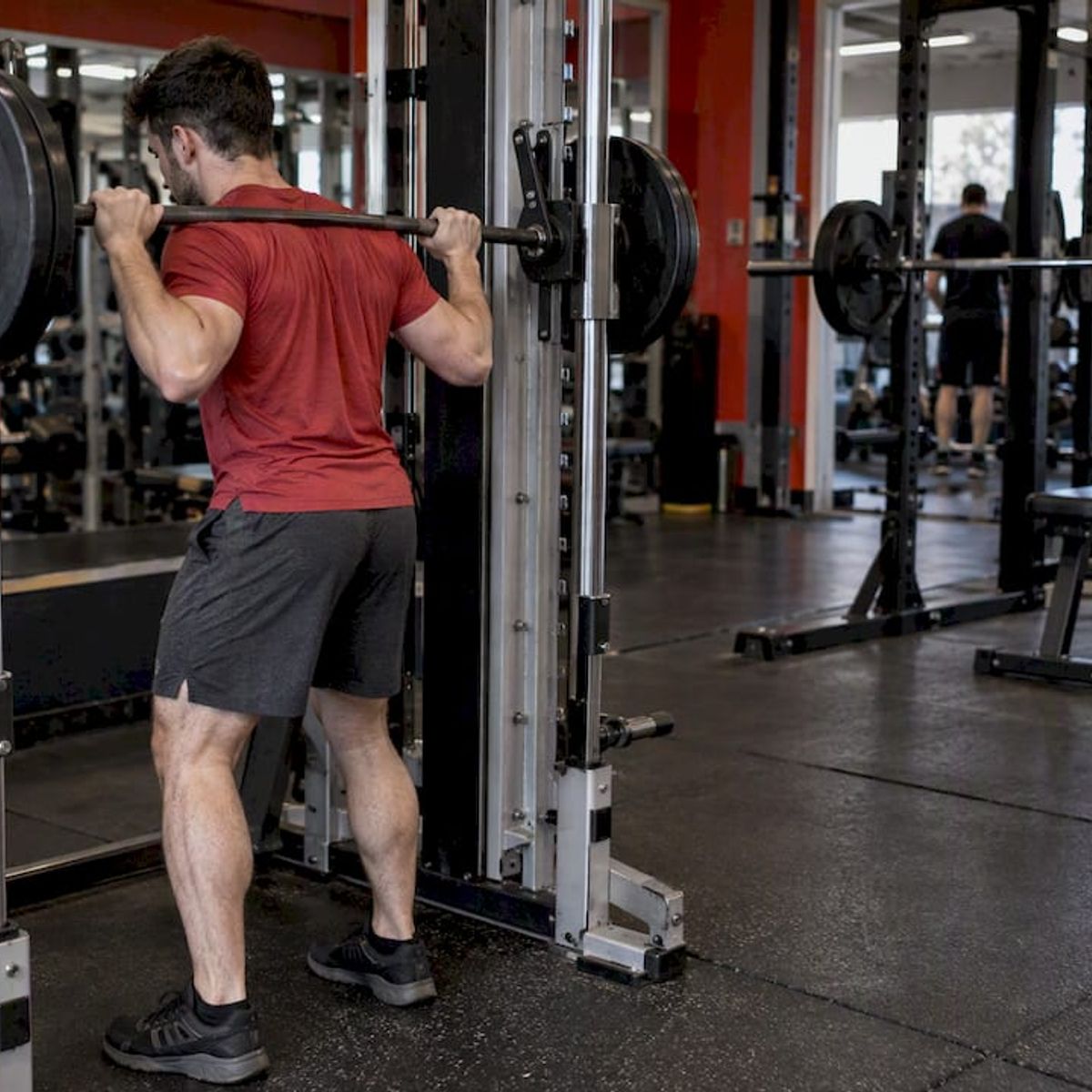
A Smith machine bolts the barbell to a fixed vertical or slightly angled track, with safety hooks you can catch at almost any point in the range. Some models use a counterweight system that lightens the bar at the bottom of the track, while others rely on simple linear bearings. Either way, the bar can only travel along one plane, which removes most of the side-to-side and front-to-back correction your body would otherwise handle.
That fixed path means you need far less stabilization to keep the bar under control, which is exactly why lifters can load it heavier than a comparable free-weight exercise and still feel steady. It also lets you train partial ranges or lock in a bar path that might not match your actual joint mechanics, since your hips, shoulders, and ankles don’t all move in a single straight line.
Common ways lifters use a Smith machine:
- Supramaximal partial squats or presses, locking the bar out of a specific range.
- Solo training sessions where no spotter is available.
- Isolation work like Smith machine lunges or calf raises where stability isn’t the training goal.
Why Free-Weight Barbell Training Demands More From Your Body
A free-weight barbell has no track to follow. The bar moves wherever your body sends it, which means your stabilizer muscles, your core, your rotator cuff, your hip stabilizers, are constantly working to keep the bar path straight and balanced over your base of support.
That demand is also the reason barbells remain the standard in powerlifting, Olympic weightlifting, and most sports performance programs. If your goal is to get stronger at squatting, pressing, or pulling a barbell, practicing with a barbell transfers directly to that skill in a way a fixed-path machine cannot fully replicate.
Practical implications for your training:
- You’ll typically need to use lighter loads than on a Smith machine while your stabilizers catch up.
- Technique coaching matters more, since there’s no track correcting your bar path.
- Barbell work builds a foundation that carries over to sport movements, real-world lifting, and unassisted strength standards.
What the Research Actually Shows
The differences between these tools aren’t just theoretical. An EMG comparison of free-weight versus Smith machine squats found roughly 43% higher average muscle activation across the gastrocnemius, biceps femoris, and vastus medialis during free-weight squats under an 8-rep-max protocol. That’s a meaningful gap in how hard your leg muscles are working for a given lift.
Muscle activation differs most in upper-body pressing. A controlled comparison of bench press and overhead press modalities found greater medial deltoid activation with free weights than with the Smith machine, and noted that dumbbells required 14 to 17% less load than barbell or Smith variations while demanding a higher stability challenge. In other words, the less stable the implement, the more your smaller stabilizing muscles get recruited, often at a lower absolute weight.
Range of motion matters too. Because the Smith machine’s track is fixed, it can force a bar path that doesn’t match your natural squat or press arc, which is part of why some lifters feel joint discomfort on the machine that they don’t feel with a free barbell. This isn’t universal: results vary by individual anatomy and by how the machine is angled.
Stability research backs up the practical pattern coaches see in the gym. A randomized training study using three stability conditions, Smith machine, free weight, and wobble board, found that all three groups improved strength and muscle thickness similarly over seven weeks, but the Smith machine group’s gains were more specific to the exact exercise trained, while free-weight training transferred more broadly to related movements.
That specificity pattern holds up at a larger scale. A 2023 meta-analysis of 13 studies covering 1,016 participants found a small advantage for free weights on free-weight strength tests, but no consistent difference in hypertrophy or jump performance between free weights and machines overall.
Load capacity and safety cut in opposite directions. The Smith machine’s fixed catches let you attempt heavier absolute loads with less risk of losing the bar, which is genuinely useful for solo lifters. But the same fixed path removes the balance training a free bar provides and can create awkward joint stress if the track’s angle doesn’t suit your body. The ACSM’s 2026 resistance-training guidance is direct about this trade-off: program individualization and consistent progressive overload matter more than which single piece of equipment you choose.
- Smith machine: higher absolute loads, less stabilizer demand, more exercise-specific gains.
- Free barbell: higher stabilizer activation, better transfer to related lifts, lower absolute load ceiling.
Matching the Tool to Your Goal
Choosing between the two comes down to what you’re training for, not which one is objectively “better.”
- Strength and sport transfer: Favor free-weight barbell practice, since the specificity principle means you get better at the lift you actually practice.
- Hypertrophy: Either tool can build muscle. Free weights tend to recruit more stabilizers, while the Smith machine can help you manage volume or isolate a target muscle without fatigue from balancing the bar.
- Rehab and novice lifters: A Smith machine can make it easier to learn a movement pattern under supervision, since the fixed path removes one variable while you build confidence.
- Accessory and supramaximal work: The Smith machine shines for partial-range overload work and lockouts, letting you handle loads you couldn’t safely re-rack with a free bar.
Pro Tip: If you’re unsure which to use for a given exercise, default to the free barbell for your main lift and save the Smith machine for your last accessory set or a partial-range finisher.
How to Train Safely on Either Setup
Technique cues shift depending on which bar you’re using, and so does your margin for error.
- Bench press: On a barbell, set safety pins just below your chest and use a spotter for heavy sets. On a Smith machine, set the hook stops at the same height and twist to unlock before pressing.
- Squat: Free-bar squats need a stable foot stance you control entirely. Smith machine squats often require stepping your feet slightly forward since the bar path is fixed behind your natural center of gravity.
- Overhead press: A free bar lets your shoulder blades rotate naturally through the press. A Smith machine can restrict that path, so keep loads moderate until you know how your shoulders respond.
- Load selection: Progress by relative effort on the barbell (percentage of your best lift) and you can be more aggressive with absolute load on the Smith machine, since the catches reduce risk.
Pro Tip: Call in a spotter or coach any time you’re attempting a new rep max on a free barbell, and rely on the Smith machine’s safety catches only as a backup, not your primary safety plan.
How We Program Barbell and Smith Machine Work at our gym
We start every new client with an assessment of their goals, mobility, and experience before deciding which tool fits a given lift. A beginner working through our 6-Week Onramp often starts with Smith machine squats and presses to build confidence in the movement pattern, then progresses to free-bar work once technique holds up under load.
- In 1-on-1 Personal Training, we build programs around your specific lift goals, choosing barbell or Smith machine work based on what actually transfers to what you want to improve.
- In Small Group PT, we often pair Smith machine accessory work with free-bar main lifts so everyone trains safely without waiting on a single rack.
- For clients focused on everyday strength and function, our approach lines up with the functional strength principles we program around.
The Honest Take on Smith Machines vs Barbells
Most of the debate over which tool is “better” misses the point: the research shows both build strength and muscle when programmed well. The real difference shows up in specificity and stabilizer demand, and most lifters benefit from using both rather than picking a side permanently.
— Malcolm
Train Both Tools the Right Way With Coached Programming
We build every client’s plan around their actual goals, whether that means free-bar squat progressions, Smith machine accessory work, or a mix of both inside 1-on-1 Personal Training, Small Group PT, or our movement library with programming templates for gym owners.
If you’re new to lifting or unsure which setup fits your body, our 6-Week Onramp pairs you with a coach who builds a written plan around your goals from day one. Start with a free class or consult and we’ll map out your first few weeks together.
FAQ
What muscles does a Smith machine work?
A Smith machine can train the same major muscle groups as a free barbell, including the quadriceps, hamstrings, glutes, chest, shoulders, and back, depending on the exercise. Because the fixed path reduces stabilizer demand, activation tends to concentrate more on the prime movers than on the smaller stabilizing muscles.
Is 225 pounds a respectable squat?
Whether a given squat weight is respectable depends on your body weight, training experience, and goals rather than a single fixed number. A strength coach can help you benchmark your squat against your own training history instead of a generic target.
Is it better to do bench press on a Smith machine?
Free-weight bench press tends to produce greater medial deltoid activation than the Smith machine version, since the free bar demands more shoulder stabilization. The Smith machine can still be useful for solo training or controlled accessory pressing when a spotter isn’t available.
Which is better for overhead press, barbell or Smith machine?
A free barbell overhead press lets your shoulder blades move through their natural path, which generally supports better long-term shoulder mechanics. The Smith machine’s fixed track can restrict that motion, so it’s best used as a supplementary option rather than your primary pressing tool.
Sources
- McCaw & Friday et al. — comparison of bench press modalities (2010)
- Resistance training with different stability requirements (PMC6443166)
- Meta-analysis comparing free-weight vs machine-based strength training (2023)
- A comparison of free-weight squat to Smith machine squat using electromyography (Schwanbeck et al.)
- ACSM resistance-training position stand (2026)