Travel Workouts and Hotel Gym Plans That Keep You on Track
The best travel workout is a short, repeatable session built on four movements (a squat or lunge, a push, a pull and a core exercise), done two or three times a week in a hotel gym or about six feet of floor. Your goal on the road is to maintain what you have built, not to set records. If you train with us at Level Up Gym in Stratford or Bridgeport, your coach can write you a travel version of your plan before you leave.
Level Up Gym
Keep Your Training Going
Level Up Gym offers hybrid training and boxing in Stratford and Bridgeport, with coaching for adults who want strength, fat loss, or boxing.
TL;DR
- Pick one lower-body, one push, one pull and one core exercise, then do them for 3 rounds. That is a complete session in 20 to 40 minutes.
- Aim for the federal baseline: strength work for all major muscle groups on two or more days a week, plus aerobic activity. Walking around a new city counts toward it.
- Pack a resistance band and, if you have space, a jump rope. Together they cover rows, presses, hamstring work and cardio.
- Keep effort moderate after a long flight, and never use furniture or doors as gym equipment unless they are built for it.
- Save a menu of 3 or 4 go-to workouts so you never have to decide on the day.
Table of Contents
- What you are actually trying to do on a trip
- A hotel gym workout plan (30 to 40 minutes)
- A hotel room workout with no equipment
- What to pack
- Build a menu, not a rigid schedule
- Safety in a hotel gym or room
- Take your plan on the road
- FAQ
- Sources
What you are actually trying to do on a trip
Most people treat travel as all or nothing: either the full gym program or nothing at all. A better target is the minimum that keeps your progress. The Physical Activity Guidelines for Americans recommend that adults get 150 to 300 minutes of moderate aerobic activity (or 75 to 150 minutes of vigorous activity) a week, plus muscle-strengthening work for all major muscle groups on two or more days a week. Those numbers are your travel floor.
In practice, that looks like two short strength sessions and a lot of walking. For a three-day work trip, you need two sessions of 20 to 30 minutes. For a spring break week, three sessions and daily walks is plenty. The guidelines also advise increasing activity gradually and choosing activity suited to your current fitness level, so a trip is not the moment to test a brand-new program.
The same idea applies to training at home on a busy week. Our post on why short workouts still work lays out the reasoning, and it carries over to travel.
A hotel gym workout plan (30 to 40 minutes)
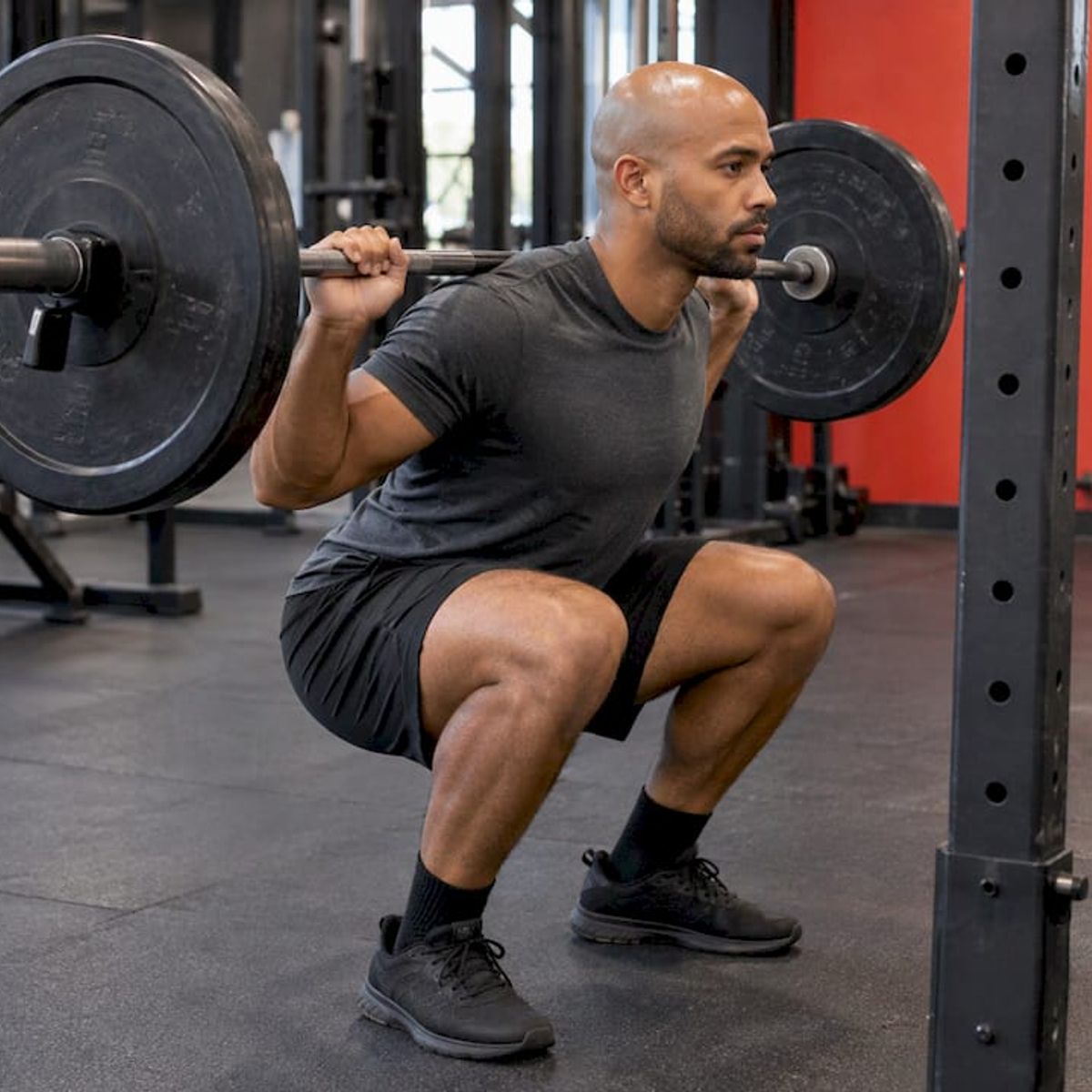
Hotel gyms usually give you a treadmill, a bike, a bench, a rack of dumbbells and sometimes a cable machine. That is enough. A hotel gym guide suggests a 30 to 40 minute session along these lines:
BlockExerciseSets x reps
Lower body
Goblet squat
3 x 10-15
Hinge
Dumbbell Romanian deadlift
3 x 10-15
Push
Dumbbell bench press
3 x 10-15
Pull
One-arm dumbbell row
3 x 10-15
Single leg
Split squat
2 x 10 per leg
Core
Plank or dead bug
2 to 3 rounds
Two tips that make this work. First, choose a weight that makes the last two reps hard but leaves your form clean. Hotel dumbbells often top out around 25 or 50 pounds, so slow the lowering phase to three seconds if the weight feels light. Second, keep rest short, about 60 seconds, so you finish on time.
If you have only 10, 15 or 20 minutes, Hotel Athlete’s approach is to pick one exercise from each category (lower body, push, pull, core) and fit the format to your time. Do them back to back as a circuit.
A hotel room workout with no equipment
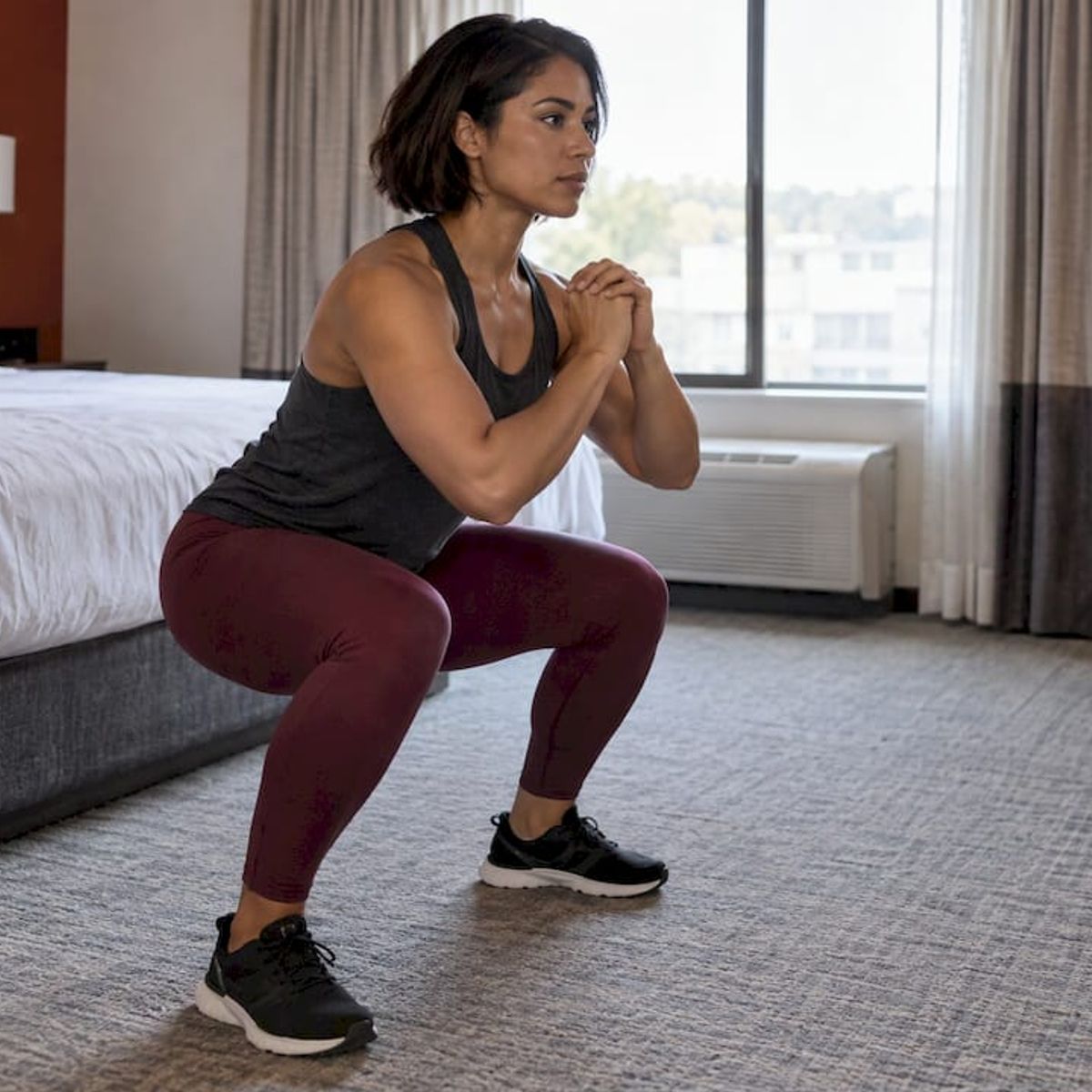
No gym, a small room, a thin wall: this is the more common situation, and it is also the one that gets skipped most. A roughly 25-minute room routine needs about six feet of floor and uses split squats, hip bridges, push-ups, backpack or band rows, wall sits, and bird dogs or dead bugs. If push-ups are too hard, put your hands on the bed or desk edge to raise the angle, as long as it is stable.
Here is a simple version to save on your phone:
- Split squats, 10 per leg
- Push-ups, 8 to 15 (hands on the bed if needed)
- Hip bridges, 15
- Backpack rows, 12 (load a backpack with books or water bottles and pull it toward your ribs)
- Wall sit, 30 to 45 seconds
- Bird dogs, 8 per side
Run through the list three times with about a minute of rest between rounds. The American Council on Exercise describes a 20-minute circuit of body weight plus resistance bands built from three rounds of about six minutes, with one minute of rest between rounds, as a centerpiece of effective travel training. ACE also notes that a go-to list of body-weight moves makes it far easier to build a session anywhere.
If you want more ideas for training with very little, see how to build strength with limited equipment.
What to pack
The best travel kit weighs less than a pair of sneakers.
- A resistance band. ACE calls bands portable and effective for travel, and its exercise list includes rows, reverse flies, chest flies, hamstring curls, walking abductions and triceps press-downs. Anchor the band around a sturdy post or hold it under your feet.
- A jump rope. It is a compact cardio tool. ACE’s Pete McCall points out that you need enough clear space to swing it without hitting furniture. In a hotel, that usually means the gym, a parking lot or a park.
- A loop band for glutes and hips. It makes bridges and squats harder in a few ounces.
Bands are also a safe starting point for people building strength with joint or bone concerns. This guide to resistance bands for bone health explains how to begin gently.
Build a menu, not a rigid schedule
A fixed Monday, Wednesday, Friday plan breaks the first time a meeting runs long. A more reliable method is a short saved menu: a walk, a familiar room workout, a hotel gym session, a swim, a local class, or rest. Then choose by the day’s time, place and energy. Flexibility is the plan working.
A sample week for a five-day business trip:
- Day 1 (arrival): Walk 20 to 30 minutes. Skip hard training.
- Day 2: Hotel gym session, 30 minutes.
- Day 3: Walk to meetings, 10-minute band circuit before bed.
- Day 4: Room workout, 25 minutes.
- Day 5: Rest or easy swim.
After long flights or a time-zone change, shift to local sleep, meal and activity times and avoid pushing to maximal effort. If your trip is short work days, our lunch break workout ideas and the plan to fit a workout into a full-time schedule use the same logic. Students on a campus visit or exam trip can use the 20-minute exam-week plan.
If you want to balance lifting and cardio, read how to balance strength and cardio. A 12-minute mobility routine is a great fit after a day in a plane seat.
Safety in a hotel gym or room
- Check the floor. Make sure it is not slippery or uneven, and avoid jumping when you are unsure about noise below you.
- Do not use furniture as equipment. Chairs, desks, towel rails and doors should not be used for support unless they are designed and confirmed for it.
- Warm up and ease in. The American College of Sports Medicine advises warming up and cooling down at an easy pace, starting with light to medium effort, and not holding your breath while you lift. It recommends 2 to 3 days a week of 2 to 4 sets of 8 to 12 challenging reps per major muscle group.
- Know when to stop. If activity worsens pain, talk to your doctor or other health care provider before continuing.
Our perspective
The hardest part of travel training is not the exercises. It is deciding what to do when you are tired, in a strange room, with 25 minutes free. That is why we write a plan with every new member, and why our coaches keep sessions simple: a squat or hinge, a push, a pull, a core move, done well.
At Level Up Gym, we blend strength, conditioning and real boxing coaching, with capped class sizes and certified coaches, including pro boxers. Once you know how your own program is built, you can strip it to its basics for a trip and come home ready to pick up where you left off. A coach can also set up online training so your plan travels with you.
> Malcolm
Take your plan on the road
If you live in Stratford, Bridgeport, Fairfield or Milford, the easiest way to travel well is to have a plan you already know. Every new member at Level Up Gym starts with a free class or consult and a written, individualized plan, with no contracts. Our online training lets a coach support you remotely, and you can see class and training options on the membership page. Beginners can start with the 6-week Onramp, listed at $699 one-off.
FAQ
How often should I work out while traveling?
Two strength sessions a week plus regular walking meets the federal baseline for muscle strengthening, which is two or more days a week. If you can fit a third short session, do it. Keep the effort moderate if you are jet-lagged.
Is a 20-minute workout enough?
Yes, for maintenance. A circuit of three rounds of about six minutes each, with a minute of rest between rounds, is a structure ACE describes for travel. Pick one exercise each for lower body, push, pull and core.
What should I do if the hotel gym has almost nothing?
Use split squats, push-ups, single-leg Romanian deadlifts and band or towel rows. A single resistance band from your suitcase covers most of what a bare gym lacks.
Should I train hard on the first day?
No. After a flight or time change, walk, stretch and keep effort easy, then build into harder sessions on day two or three as your sleep and appetite settle.
Sources
- Physical Activity Guidelines for Americans, 2nd edition
- ACSM Exercise is Medicine: Being Active With Mobility Limitations
- ACE: Quick-hit Workout: Resistance Bands
- ACE: Body-weight Training
- ACE: Health Benefits of Jumping Rope
- Hotel gym workout guide
- Hotel Athlete workout module
- How to stay fit while traveling without a full gym
- Men’s Fitness: the workout you can do anywhere
- Resistance bands for bone health