How to Start Boxing at 30 (or 40): A Beginner’s Guide
You are not too old. Thirty, forty and beyond are normal ages to walk into a boxing gym for the first time, and you can build real skill and fitness without ever getting hit. What matters is how you start: with a coach, at low intensity, and with a plan that leaves room to recover.
This guide covers what age does and does not change, what your first weeks look like, what to buy, how to train safely after 40, and how to fit boxing into a normal adult schedule in Fairfield County.
Level Up Gym
Start Boxing With Coaching
Level Up Gym offers hybrid training and boxing in Stratford and Bridgeport, with beginners welcome.
TL;DR
- Age is not a barrier. USA Boxing has no maximum age limit and has members in their 70s who still compete.
- Most adult beginners never need to spar. Bag work, mitts, footwork and conditioning build the skill and the fitness.
- Start easy: two to three sessions a week, with recovery days between, and let technique come before power.
- Over 40, mention any heart or joint symptoms to your doctor before you ramp up, then build intensity gradually.
- At Level Up Gym, every new member starts with a free class or consult and a written, individualized plan.
Table of Contents
- Is 30 or 40 too old to start boxing?
- What changes after 30 and 40
- Fitness boxing versus competitive boxing
- What your first weeks look like
- How to train safely after 40
- What gear you actually need
- What to look for in a beginner boxing gym
- Start boxing with Level Up Gym in Stratford or Bridgeport
- Common worries, answered
- FAQ
- Sources
Is 30 or 40 too old to start boxing?
No. The sport’s own governing body says so in its rules. USA Boxing states that it has no maximum age limit, and that boxers ages 35 to 40 can compete in elite, masters or both divisions, while those 41 and older are classified as masters.
There is also a division built for people starting later. USA Masters Boxing is an amateur division for ages 35 and older. Competitors need a yearly physical, and those 45 and older also need to pass an exercise stress test (EKG) that is good for five years. That is a competition requirement, not a rule for training in a gym, but it shows how seriously the sport takes older athletes’ health and how well it makes room for them.
The honest question for most 30-somethings and 40-somethings is not “am I too old?” but “what do I want from this?” Most people want one of four things:
- A workout that does not feel like a workout
- Fat loss and conditioning
- A new skill with a clear sense of progress
- A way to release stress after a long day
All four are available without ever stepping into a ring. If you dream of competing, the amateur ladder has a place for you. If you do not, nobody will push you toward it.
What changes after 30 and 40
Your body still adapts. What shifts is the margin for error.
Recovery takes longer. After 40, you will likely need more rest between hard sessions and a longer warm-up for your joints. Plan for two to three boxing workouts per week with recovery days in between, which is the advice Cleveland Clinic’s Dr. Edwards gives beginners.
Technique protects you. Throwing a punch uses your legs, hips, core and shoulder in sequence. When that chain is sloppy, the wrist, elbow or shoulder takes the load. A coach who corrects your stance early saves you months of nagging aches.
Power is the last thing to build. Learning to control your power is one of the most valuable early skills, and working at moderate intensity reduces joint stress. Slamming a heavy bag at full effort in week one is the fastest way to get hurt.
Your hands and wrists need respect. Good wraps and gloves matter more at 40 than at 20. Our guide to 180-inch Mexican hand wraps explains how to wrap for adult wrists.
Fitness boxing versus competitive boxing
This distinction removes most of the fear. Harvard Health describes fitness boxing as a version of the sport with no ring, no punches taken and no risk of head trauma. You throw punches at the air or a punching bag, usually in a class.
The same article lists what it does for you: it improves upper-body strength, core, back and leg strength, boosts aerobic endurance, sharpens eye-hand coordination and improves balance. It also notes that people with osteoporosis or osteoarthritis of the hands should consider shadow boxing only, which is the kind of thing to tell your coach on day one.
If you want a sense of how this works with no partner at all, read our shadow boxing workout for beginners. And if sparring worries you, our coach-led four-week plan for boxing without sparring shows how much skill and fitness you can build without it.
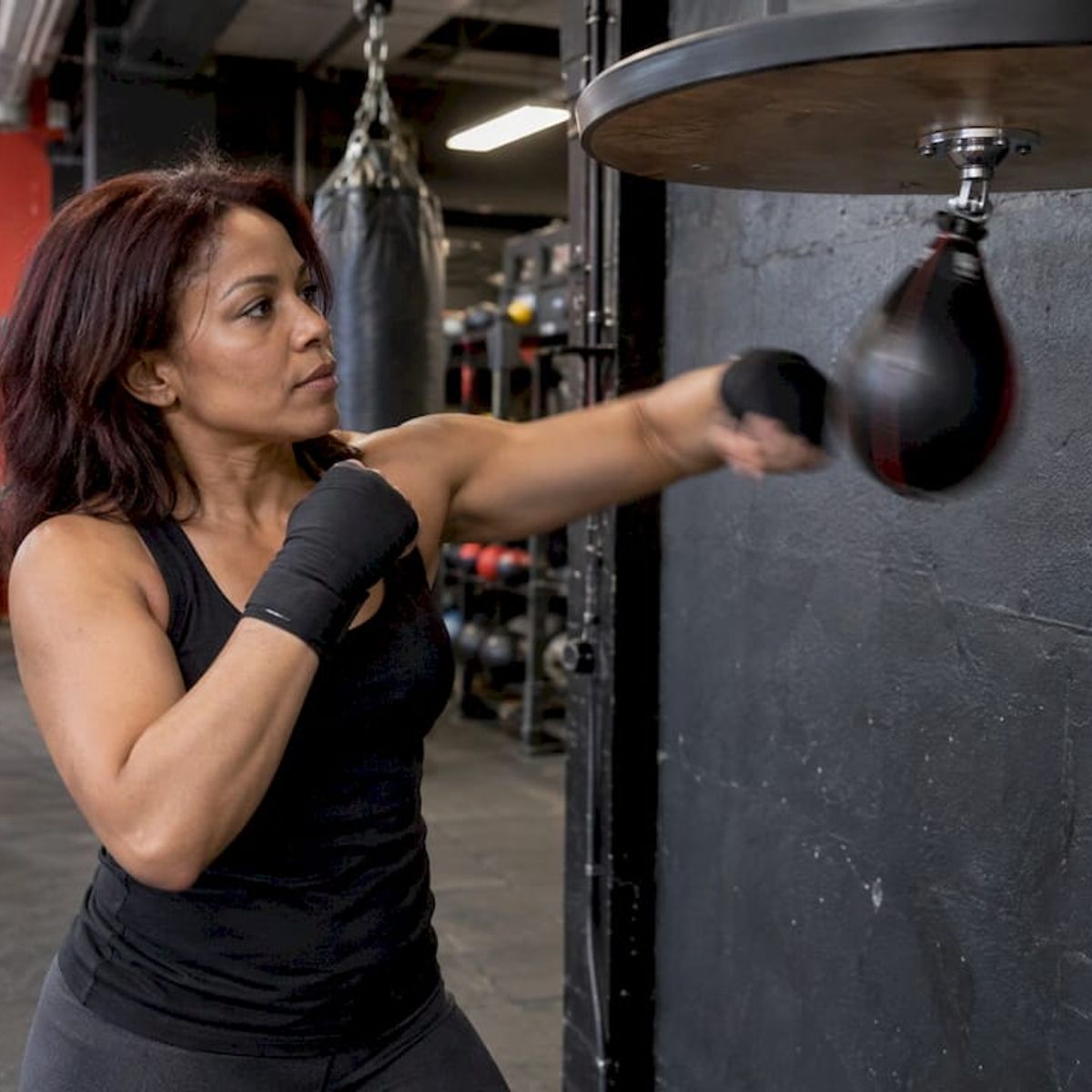
In the US, there is even a formal version of this path. USA Boxing sells a non-contact Fitness membership for adults 18 and over at $35 per year. It covers working out in a registered gym, training with a coach, and using heavy bags, speed bags and punch mitts, and it explicitly excludes sparring.
What your first weeks look like
A good beginner program is boring in the best way. Expect to spend the first sessions on the basics, not on throwing hard.
Week 1 to 2: stance, footwork and the basic punches
Boxing starts with stance. Cleveland Clinic’s Dr. Edwards says beginner workouts typically combine shadowboxing, footwork drills, jump training and strength exercises. You learn where your feet go, how to hold your guard, and the jab, cross, hook and uppercut, usually numbered so a coach can call combinations.
You will feel clumsy. That is normal and it passes faster than you expect, because the work is partly mental. Dr. Edwards describes boxing as almost a brain game, since you are thinking about which punches to throw and in what order, and that coordination between brain and body is part of what makes it good for you.
Week 3 to 4: bag work and mitts
Once your stance holds up, you start hitting something. Heavy-bag work teaches you to land a punch with your whole body. Keep it controlled: a lot of experienced older trainees keep most bag rounds at around half effort while they sharpen technique. Our guide on how to use a heavy bag for fitness breaks down cardio, strength and technique rounds.
Week 5 to 6: combinations and conditioning
Now you string punches together, add slips and pivots, and work in rounds. Conditioning builds around the boxing: rope, core, legs and short intervals. If you want to know what that part of class feels like, see our page on the boxing conditioning class.
By about six to eight weeks of three to four weekly sessions, most adults notice real changes in fitness. That is why our beginner program runs six weeks.
How to train safely after 40
This is the section for the “boxing for beginners over 40” crowd, and for anyone who has been sedentary for a while.
Check in with your doctor when it applies
The MSD Manual says people over 40 starting an exercise program should report heart disorders or arthritis and describe symptoms such as chest pain, shortness of breath, palpitations or joint pain. It adds that most people do not need an exercise stress test, and many do not need an ECG, if they plan to increase intensity gradually. So the practical advice is to talk to your primary care doctor if you have any of those symptoms or a known condition, and then to build up slowly.
Start lower than your ego wants
The same source says the safest way to start is at low intensity, which gives you time to learn technique and prevent injury. If your muscles ache after just a few minutes, your first workout should last only that long. Boxing fitness is built from many small sessions, not one heroic one.
Use a simple weekly structure
Dr. Edwards recommends 150 minutes of moderate exercise each week for beginners, spread across 15-, 30- or 45-minute sessions. For context, U.S. health guidelines suggest 75 to 150 minutes a week of moderate to vigorous activity. A realistic first month for a busy adult:
DayWhat to doNotes
Monday
Coached boxing class
Focus on form, not force
Tuesday
Walk or light mobility
Easy movement counts
Wednesday
Coached class or small-group session
Add strength work
Thursday
Rest
Sleep and food matter here
Friday
Coached boxing class
Rounds on the bag
Weekend
Optional shadow boxing at home
15 to 20 minutes
If your schedule is tight, our plan for boxing training at home covers the days you cannot get to the gym.
Listen to pain and swelling
Cleveland Clinic’s advice is to ease in, use good form taught by a trainer, wear the right gear, listen for pain or swelling and make time for recovery. Muscle soreness the next day is normal. Sharp joint pain, swelling in a hand or wrist, or pain that gets worse as you warm up is a reason to stop and tell your coach. Persistent or severe pain deserves a visit to a doctor or physical therapist. Our injury prevention templates for adults give you two starter routines for this.
If you are closer to 50 or beyond, see our starter plan for adults 50+.
What gear you actually need
You do not need to spend much. On day one the essentials are:
- Hand wraps. They support the small bones of the hand and the wrist. The standard adult length is 180 inches, which we cover in our hand wraps guide.
- Gloves. Adult beginners usually train in mid-weight bag gloves. Ask your coach to size them to your hand and your goals before you buy.
- A mouthguard. Needed once you do partner drills that involve contact, and optional until then.
- Athletic clothes and training shoes you can move in.
Jump ropes, reflex bags and boxing shoes can wait. At our gyms, coaches help you choose gear, so you do not buy the wrong thing in your first week.
What to look for in a beginner boxing gym
Whether you train with us or not, these are the questions worth asking:
- Is the coaching real boxing? Cardio-boxing classes are fun, but you will not learn stance, footwork or defense from a playlist and a count.
- Are classes capped? You want a coach who can see your feet and your guard.
- Is there a clear beginner path? A defined onramp beats being dropped into an advanced class.
- Is sparring optional? It should be.
- Are there contracts? Month-to-month membership lets you find out whether you love it before committing.
- Will someone write down a plan for you? A written plan keeps you consistent when motivation dips.
Our perspective
We built Level Up Gym around a simple belief: adults who start late deserve the same quality of coaching as someone who walked into a boxing gym at 16. That is why our boxing is real boxing, not cardio boxing, and why some of our coaches are pro boxers who know exactly how a jab should look and how a beginner should build toward it.
The people who thrive at 30, 40 and beyond are rarely the ones with the best genes. They are the ones who show up two or three times a week, learn the basics properly and recover well. So we cap class sizes, so a coach can actually correct you, and we prioritize beginners instead of treating them as an afterthought.
We also pair boxing with strength and conditioning, because the strongest, fittest version of you throws better punches and stays injury-free longer. Every new member starts with a free class or consult and a written, individualized plan, and there are no contracts, so the only reason to keep coming is that it is working for you.
Malcolm
Start boxing with Level Up Gym in Stratford or Bridgeport
If you live in Fairfield, Bridgeport, Stratford, Milford or nearby, you can try it without a commitment. Every new member starts with a free class or consult and a written plan built around your goals, schedule and any injuries. You can book a free boxing class in Stratford to see what a coached session feels like.
If you want a structured beginning, our 6-week Onramp is a one-off $699 program built for newcomers. For ongoing training, our membership page lists the options as published:
OptionPublished price
Large group classes
$24.99 to $59.99 per week
Small group personal training (2 to 4 people)
$74.99 to $174.99 per week per person
1-on-1 personal training
$149.99 to $359.99 per week
You can read more about our boxing classes, or look at our kickboxing classes if you want to add kicks. If you are a student or commuter who cannot be at the gym every week, our online training keeps your plan going between visits.
Common worries, answered
“I am out of shape.” That is the reason to start with a coach. Boxing sessions are built in rounds with rest, so you set the pace, and you can scale each one.
“I will look foolish.” Everyone looks awkward in the first two weeks. Beginners are the majority in a beginner program, and good coaches have seen every version of a first jab.
“I have a desk job and a bad back.” Tell your coach on day one. Footwork, core work and shadow boxing can be adjusted, and a doctor’s guidance comes first if you have a diagnosed condition.
“I am a student on a budget.” Start with the free class, then compare group class pricing with what you would pay for a regular gym plus classes elsewhere. No contract means you can pause when finals hit.
FAQ
Is 30 too late to become a boxer?
No. USA Boxing says it has no maximum age limit, and it has a masters division for ages 35 and older. If you want to compete, talk to a coach about the amateur route. If you want fitness and skill, you can train without ever fighting.
Is 40 too old to start boxing?
No, but start more gradually. Recovery takes longer, so plan two to three sessions a week with rest days between and learn technique before adding power. If you have chest pain, shortness of breath, palpitations or joint pain, see your doctor first, as the MSD Manual advises for people over 40.
Do I have to spar to learn boxing?
No. Fitness boxing involves no ring and no punches taken, only bags, mitts and air. Most adult beginners get everything they want from bag work, pad work and conditioning, and you can decide on sparring later, or never.
How often should a beginner over 40 train?
Two to three boxing sessions per week is a sound start, with recovery days in between. Add strength work and easy daily movement as you adapt. Increase gradually and back off if you feel pain or swelling.
What should I bring to my first class?
Wear comfortable athletic clothes and training shoes, and bring water. If you have wraps, bring them. If not, ask your coach, who can show you how to wrap and help you choose gloves before you spend money.
Sources
- USA Boxing Membership
- USA Boxing Fitness Membership
- USA Masters Boxing
- Harvard Health: Punch up your exercise routine with fitness boxing
- Cleveland Clinic: Beginner-Friendly Boxing Workout
- MSD Manual: Starting an Exercise Program
- Today.com: Boxing Benefits